Peyote (Complete Guide): Botany, History, Legal Status & Conservation
An educational look at peyote - the small spineless cactus of the North American deserts - covering what it is, where it grows, its deep cultural history, its legal status, and why conservationists are worried.
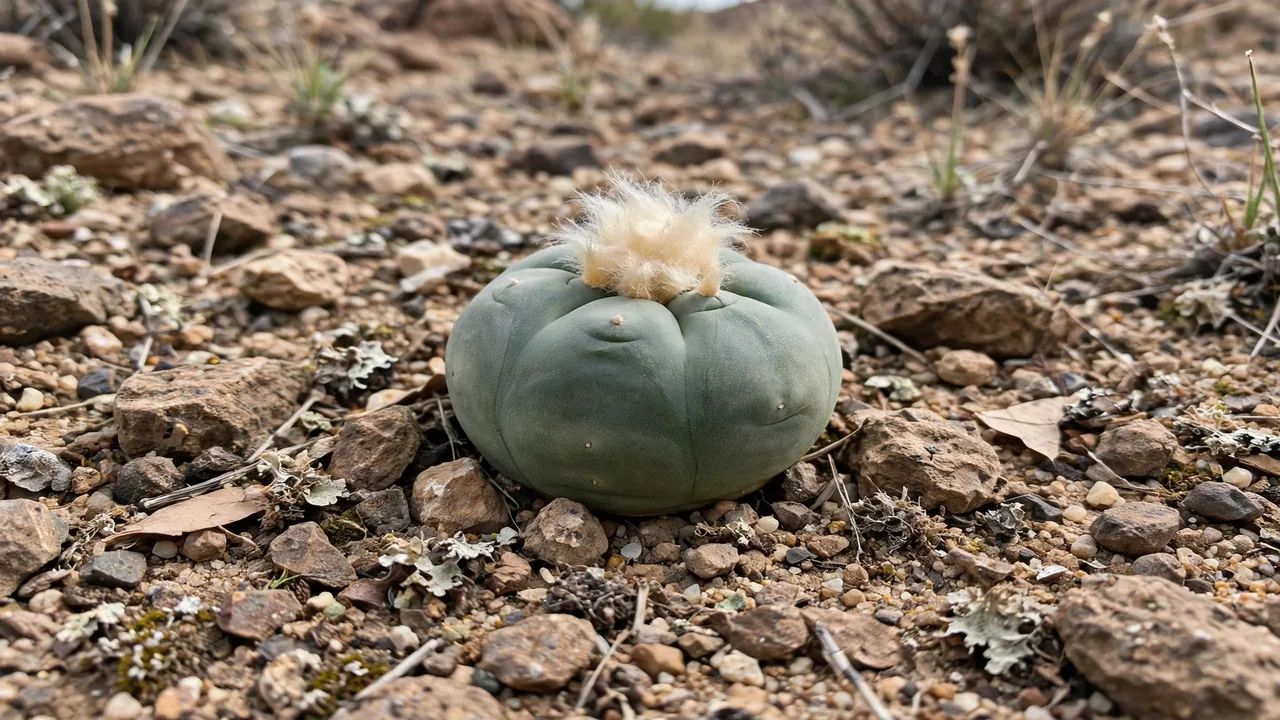
Peyote is one of the most misunderstood plants in North America. To botanists, it is Lophophora williamsii – a small, spineless cactus that grows with extraordinary slowness in the deserts of southern Texas and northern Mexico. To several Indigenous traditions, it is a sacred plant with thousands of years of ceremonial history. To lawmakers, it is a controlled substance with a unique religious exemption. This guide is purely educational: it covers the botany, the history, the law, and the conservation story – no instructions, no encouragement, just verifiable facts.
In this article
- What peyote is, botanically speaking
- Where peyote grows in the wild
- A cactus built for patience: growth and lifespan
- Thousands of years of history
- Indigenous traditions
- The Native American Church
- Peyote and the law
- A cactus in trouble: conservation
- Peyote vs. similar cacti
- Common myths about peyote
- FAQs
What Peyote Is
The short answer
Peyote is a small, nearly spineless cactus in the genus Lophophora. Unlike the tall, ribbed cacti most people picture, peyote grows as a low, rounded, blue-green button barely rising above the soil. The above-ground portion – called the crown – is divided into rounded segments and topped with a tuft of woolly hairs. In the right season it produces small pink or white flowers. Nearly all of the plant’s mass is actually underground in a thick taproot, an adaptation for surviving long dry spells.
Scientific name: Lophophora williamsii – the best-known of the small Lophophora genus.
Plant family: Cactaceae – the cactus family.
Size: Typically 2 to 7 centimeters tall above ground, though old specimens can be wider than a fist.
Spines: Effectively none – the areoles bear soft tufts of hair instead of sharp spines.
Key chemistry: Contains mescaline (3,4,5-trimethoxyphenethylamine) and related alkaloids – the reason for its cultural and legal significance.
The name “peyote” comes from the Nahuatl word peyotl, used by Nahua peoples of central Mexico. Spanish chroniclers recorded the plant in the 16th century, by which time it already had a long ceremonial history behind it.
Where Peyote Grows
Peyote is a desert specialist with a narrow range. In the wild it occurs in the Chihuahuan Desert region – southern Texas in the United States and the Mexican states of Coahuila, Nuevo Leon, Tamaulipas, San Luis Potosi, and Zacatecas. It favors limestone-rich soils and often grows partly shaded beneath thorny nurse shrubs, which shelter young plants from the harshest sun. It is not a plant of lush places; it is a plant of caliche flats, rocky slopes, and scrubland where little else bothers to grow.
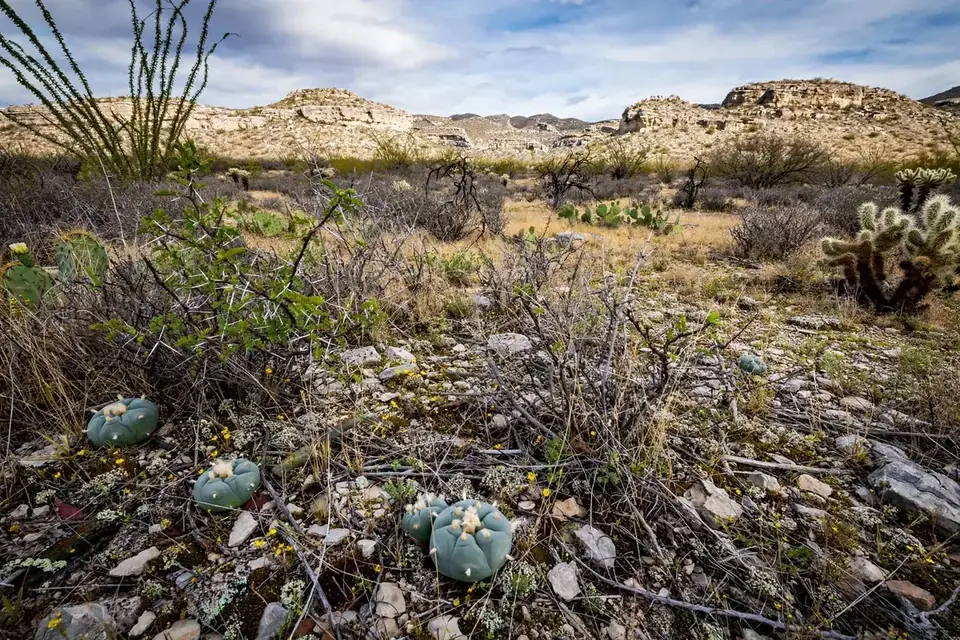
This narrow habitat preference is one reason the species is vulnerable. Peyote cannot simply be found “anywhere in the desert” – it needs the right soils, the right rainfall pattern, and the right plant community around it. Remove those, and the cactus has nowhere to go.
A Cactus Built for Patience
Peyote is one of the slowest-growing cacti known. A plant can take 10 to 30 years to reach maturity from seed, adding only millimeters of growth in a good year. Individual plants can live for many decades, and some old specimens in the wild are thought to be far older than the people harvesting them. Flowering happens in the warmer months, and the small fruits that follow contain the seeds for the next unhurried generation.
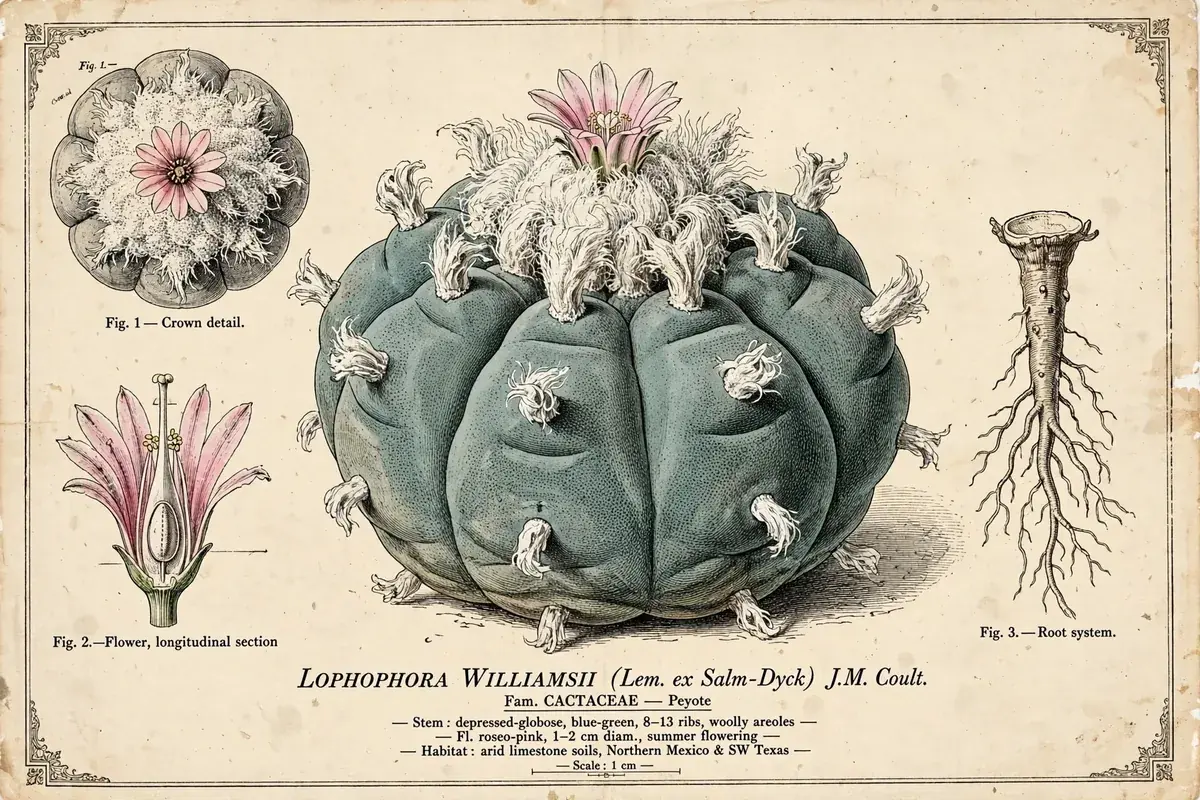
That slowness shapes everything about the plant’s story. A cactus that needs decades to mature cannot quickly replace harvested populations – a fact that sits at the center of the conservation debate. It also means that the “buttons” – the disc-shaped crowns – represent years of growth each, which is part of why wild harvesting has such an outsized impact.
Thousands of Years of History
Archaeological evidence places peyote use in North America at more than 5,700 years ago – among the oldest documented relationships between humans and a psychoactive plant anywhere in the world. Researchers carbon-dated preserved peyote specimens from a Texas rock shelter to 3780-3660 BC and confirmed the presence of mescaline in the ancient material, showing that the plant’s chemistry and its human use go back millennia together.
By the time Spanish colonizers arrived in the 1500s, ceremonial peyote use was widespread in the Aztec Empire and northern Mexico. Spanish missionaries documented it extensively – mostly to condemn it – and colonial authorities repeatedly tried to suppress it. The suppression largely failed; the traditions persisted, adapted, and eventually spread northward into what is now the United States, where peyote ceremonialism took new forms among Plains and southwestern tribes in the 19th century.
Indigenous Traditions
Several Indigenous peoples of northern Mexico maintain peyote traditions stretching back centuries. The best documented is that of the Wixarika (Huichol) people, for whom the cactus – known as hikuri – is central to religious life. Wixarika pilgrims traditionally travel to Wirikuta, a sacred desert region in San Luis Potosi, to gather the cactus as part of elaborate ceremonial cycles tied to deer, maize, and the sun. These are living religious practices, not historical curiosities, and they continue today alongside modern pressures on both the land and the plant.
Other groups, including the Tarahumara (Raramuri) and various Cora and Tepehuan communities, have their own historical and contemporary relationships with the cactus. What these traditions share is a framework in which peyote is a sacred being and a teacher, approached through prayer, song, and community ceremony – a context entirely different from recreational drug use, and one that outsiders have often misunderstood or misrepresented.
The Native American Church
In the United States, peyote ceremonialism is most visibly organized through the Native American Church (NAC), a pan-tribal religious movement formally organized in Oklahoma in 1918. The NAC blends Indigenous peyote traditions with Christian elements, and its ceremonies – typically all-night prayer meetings centered on the sacramental use of peyote – are attended by an estimated 250,000 to 500,000 members across many tribes and states.
The NAC’s history is inseparable from a long legal struggle. For much of the 20th century, members faced prosecution for possessing a plant central to their religion. That struggle produced landmark court cases and, eventually, explicit federal protection – which brings us to the law.
Peyote and the Law
Peyote occupies an unusual corner of drug law – simultaneously prohibited and protected. Here are the key facts:
- Federal scheduling: In 1970, mescaline and the peyote cactus itself were placed in Schedule I of the U.S. Controlled Substances Act, the category for substances deemed to have high abuse potential and no accepted medical use.
- Religious exemption: The American Indian Religious Freedom Act of 1978, strengthened by 1994 amendments, explicitly protects the harvesting, possession, and use of peyote for bona fide religious ceremonies. Under federal law (42 U.S.C. section 1996a), members of the Native American Church may use peyote as a sacrament.
- Scope of the exemption: The protection is narrow – it covers genuine religious use by NAC members, not possession or use by the general public. Outside that exemption, peyote remains illegal under federal law.
- State variation: Several states have their own exemptions or case law around religious peyote use, while others rely on the federal framework. The legal picture is not identical everywhere.
- International law: Mescaline – but not the peyote plant itself – is controlled under the 1971 UN Convention on Psychotropic Substances. Peyote is additionally listed on CITES Appendix II, which regulates its international trade to prevent overexploitation.
The bottom line for readers: this is not a gray area you can navigate casually. For everyone outside the protected religious context, peyote is a controlled substance, full stop. This article describes the law; it does not offer a way around it.
A Cactus in Trouble: Conservation
Perhaps the most urgent part of peyote’s story has nothing to do with law or religion – it is ecological. The IUCN Red List classifies peyote as Vulnerable, and the pressures are well documented:
- Slow growth vs. fast harvest: A plant needing decades to mature cannot sustain heavy harvesting. Wild populations in Texas – the only U.S. source – have declined significantly under combined pressure.
- Habitat loss: Land conversion, development, and changes in land use shrink the already narrow range where peyote can grow.
- Poaching and overharvesting: Demand – religious, illicit, and collector-driven – draws more plants out of the desert than the desert can replace.
- Climate stress: Shifting rainfall patterns in the Chihuahuan Desert threaten a plant already living at the edge of what is survivable.
Conservationists, researchers, and many Indigenous practitioners agree on the diagnosis even when they differ on solutions: the wild cactus is in decline, and protecting remaining populations – through habitat preservation, regulated harvest, and cultivation for legitimate religious supply – is the shared priority. For readers who follow nature and conservation topics, dailyscope67.com covers related stories on wildlife, landscapes, and the natural world.
Peyote vs. Similar Cacti
Peyote is sometimes confused with other cacti, especially by people who have only seen pictures. The distinctions matter – botanically and legally:
| Cactus | How it differs from peyote |
|---|---|
| San Pedro (Trichocereus pachanoi) | A tall, columnar cactus – the opposite growth form. Also contains mescaline, but is a completely different plant, widely grown ornamentally. |
| False peyote (Ariocarpus fissuratus) | A related Chihuahuan Desert cactus with a similar low profile, but deeply fissured tubercles and no mescaline. Sometimes called “living rock.” |
| Peyotillo (various Mammillaria) | Small globular cacti sometimes confused at a glance, but with prominent spines – peyote is effectively spineless. |
Common Myths About Peyote
Myth: Peyote is legal because it is natural. Fact: “Natural” has no legal meaning. Peyote is a Schedule I controlled substance for the general public in the United States, with a narrow religious exemption.
Myth: The religious exemption means anyone can claim it. Fact: The federal protection covers bona fide religious ceremonies of the Native American Church – courts and agencies do not treat casual or recreational use as protected.
Myth: Peyote is abundant because deserts are big. Fact: Peyote needs specific limestone soils and plant communities; its actual range is narrow, its growth is extremely slow, and wild populations are declining.
Myth: All “peyote” sold online is the real cactus. Fact: A significant share of what is marketed – especially seeds and dried material – is misidentified, mislabeled, or outright fraudulent, and purchasing it is illegal in most jurisdictions regardless.
Why Peyote Matters Beyond the Headlines
Peyote sits at the intersection of three stories that each matter on their own. For botanists, it is a marvel of desert adaptation and a case study in how slowly some life moves. For Indigenous peoples and scholars of religion, it is a living tradition thousands of years deep, still practiced today. And for legal history, the fight over peyote helped define the boundaries of religious freedom in the United States. Strip away the sensationalism, and what remains is a small, slow, vulnerable cactus carrying an outsized cultural weight – which is exactly why it deserves to be understood accurately.
Frequently Asked Questions
Is peyote a cactus?
Yes. Peyote (Lophophora williamsii) is a true cactus in the family Cactaceae – just an unusual one: small, round, and effectively spineless, growing close to the ground in desert scrubland.
Is peyote legal?
For the general public in the United States, no – it is a Schedule I controlled substance. Members of the Native American Church have an explicit federal exemption for bona fide religious use under the American Indian Religious Freedom Act as amended in 1994. Laws vary by country and, within the U.S., by state.
How long does peyote take to grow?
An exceptionally long time. From seed to maturity typically takes 10 to 30 years, with individual plants living for many decades. This slow growth is central to its conservation problems.
Is peyote endangered?
It is classified as Vulnerable on the IUCN Red List – not yet endangered, but declining, primarily due to overharvesting, habitat loss, and its own slow growth. It is also listed on CITES Appendix II, which controls international trade.
What is mescaline?
Mescaline (3,4,5-trimethoxyphenethylamine) is the principal psychoactive alkaloid in peyote and several other cacti. It is itself a Schedule I controlled substance in the United States and is controlled internationally under the 1971 UN Convention on Psychotropic Substances.
Where does the word “peyote” come from?
From the Nahuatl word peyotl, used by Nahua peoples of central Mexico – a linguistic trace of just how deep the plant’s history in the region runs.
Reead Also: Water Tower Water Tower: How These Giant Tanks Work (2026 Guide)
#peyote #botany #education

Related Articles

Location Isle of Man: Where Is It and Why Visit It
The Isle of Man sits in the middle of the Irish Sea, between Great Britain and…

5 Pillars of Muslim Faith Explained Simply (2026 Guide)
The Five Pillars of Islam — Shahada, Salah, Zakat, Sawm and Hajj — are the foundation…

Conferences 2024: Education Events Guide and Lessons
Conferences in 2024 gave educators a busy year of in-person and hybrid events. This guide looks…
3 Comments