Quartz (2026 Guide): What This Common Mineral Is, Its Properties, Types & Uses
Everything you need to know about quartz - the silicon dioxide mineral behind glass, gemstones, and electronics - explained simply.
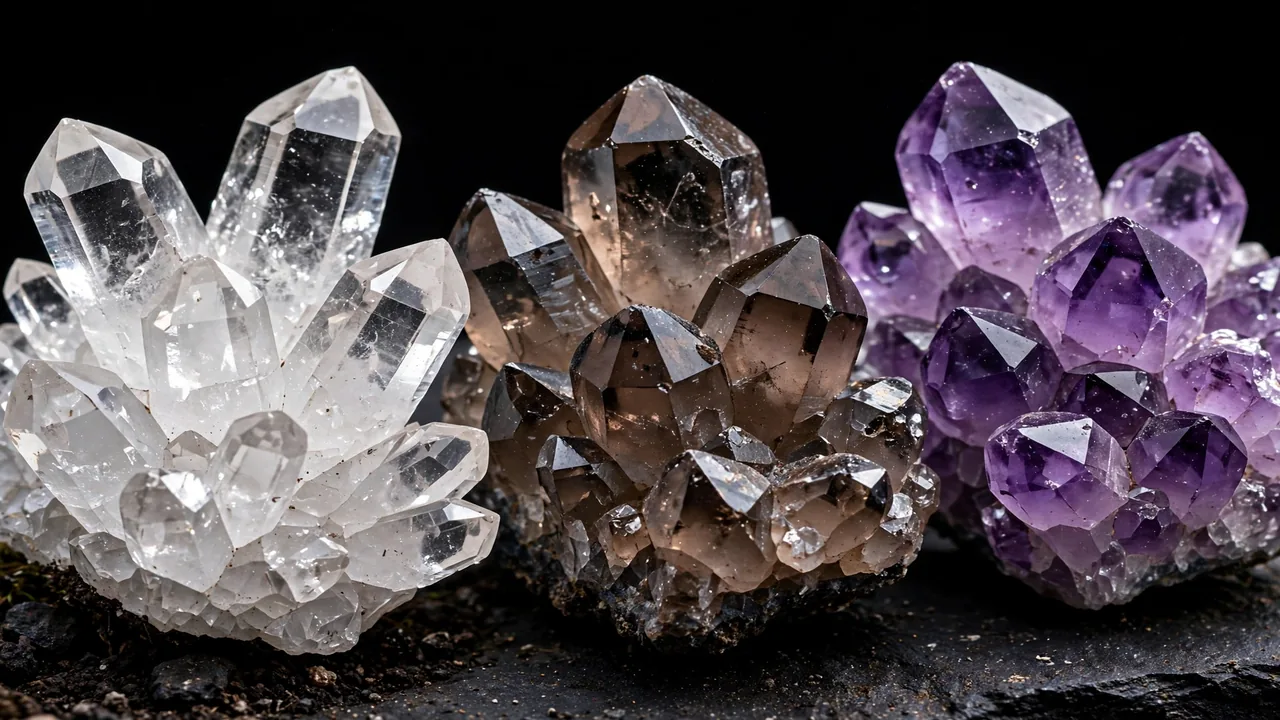
Pick up a handful of beach sand and you are holding quartz. Glance at the screen you are reading this on – quartz made the glass possible. If your watch ticks with a quartz movement, there is a tiny sliver of this mineral inside, vibrating thousands of times a second to keep time. And that purple amethyst in someone’s jewelry box? Also quartz. Few minerals touch everyday life as quietly and completely as this one, yet most people could not tell you what quartz actually is, beyond “some kind of crystal.” This guide fixes that.
In this article
- What quartz is, in plain language
- Where quartz comes from and where it forms
- The many faces of quartz: amethyst, citrine, rose quartz, and more
- The properties that make quartz special
- How quartz is used – from glass to electronics
- Quartz countertops: pros and cons
- Quartz vs. look-alike minerals
- Looking after quartz
- FAQs
What Is Quartz?
The short answer
Quartz is a mineral made of silicon and oxygen – the two most abundant elements in Earth’s crust, locked together in a repeating three-dimensional framework. Its chemical formula is SiO2, silicon dioxide. It is the second most abundant mineral in Earth’s continental crust (after feldspar), and because it is hard and chemically stubborn, it outlasts nearly every other mineral when rocks weather away. That durability is why quartz dominates sand, gravel, and riverbeds worldwide.
Chemical formula: SiO2 – one silicon atom bonded to two oxygen atoms in a continuous framework.
Mineral class: Silicate – the largest and most important family of rock-forming minerals.
Hardness: 7 on the Mohs scale – harder than glass, steel files, and most common minerals.
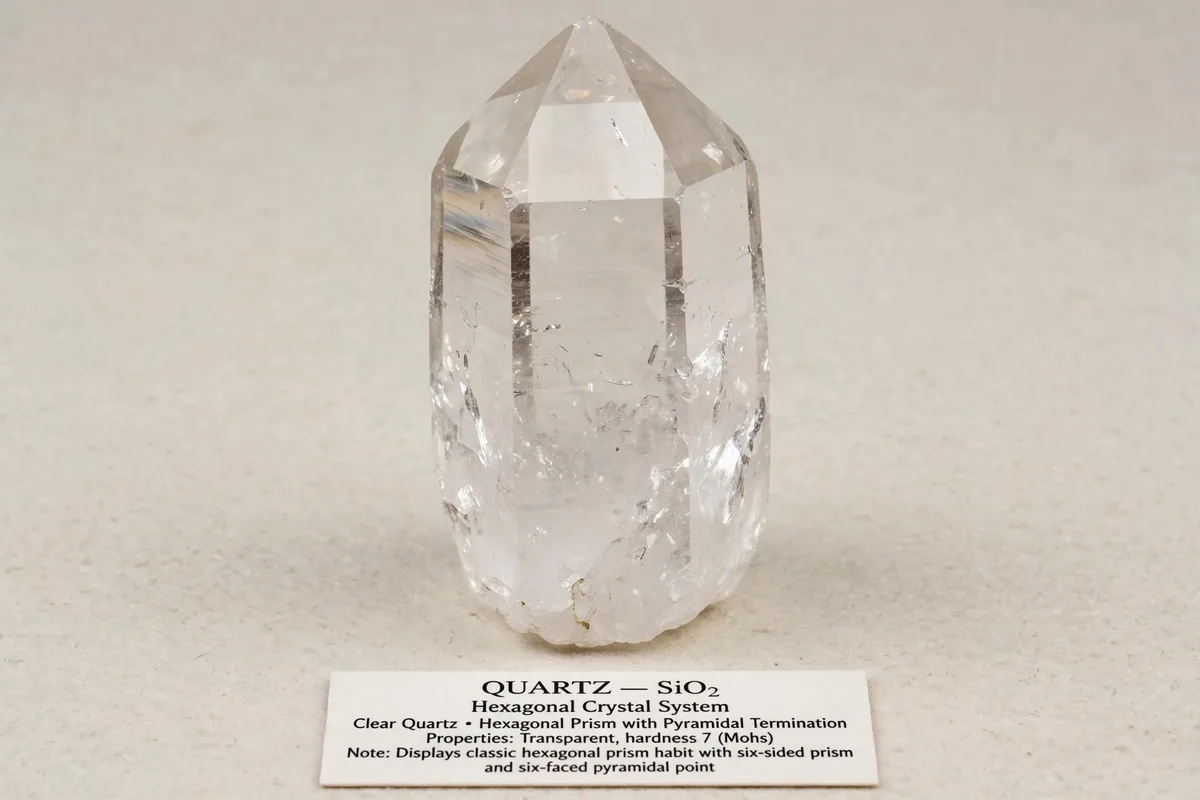
Crystal system: Trigonal – in hand specimens it typically grows as six-sided prisms capped by pyramid-like points.
Breakage: No cleavage; it breaks with a conchoidal (curved, shell-like) fracture and a glassy luster.
One thing quartz is not is a rock. Rocks are mixtures of minerals; quartz is a single mineral. Granite, for example, is a rock that commonly contains quartz alongside feldspar and mica. When people say a beach is “made of quartz sand,” they mean the sand grains are mostly this one mineral, concentrated there because everything softer weathered away first.
Where Quartz Comes From
Quartz forms in an unusually wide range of geological settings, which is one reason it is everywhere. It crystallizes directly from silica-rich magma as granite cools. It precipitates from hot, mineral-laden water moving through cracks in rock, building the milky-white veins you can spot in road cuts and cliffs. It cements loose sand grains together during burial, turning sand into sandstone – and under the heat and pressure of metamorphism, sandstone becomes quartzite, a rock that is nearly pure quartz. Because quartz resists both chemical attack and physical grinding, it survives erosion cycle after cycle, which is why so much of the world’s sand is quartz even in places far from any quartz source.
Major deposits exist on every continent, but some localities are famous among collectors and industry alike: the amethyst geodes of Brazil and Uruguay, the rock-crystal pockets of Arkansas in the United States, the rose quartz of Madagascar, and the vast high-purity quartz veins worked for the electronics industry. Quartz is, in a real sense, one of the building blocks of rocky worlds – the same silica chemistry shows up wherever rocky planets assemble from dust and gas, as explained in this guide to how planets form from cosmic dust.
The Many Faces of Quartz
Ask ten people to picture quartz and you will get ten different answers – water-clear crystal points, purple amethyst, pink rose quartz, smoky brown points, banded agate. They are all quartz. The color differences come from trace impurities and natural irradiation, not from a different chemistry:
| Variety | Appearance | What gives it color |
|---|---|---|
| Rock crystal | Colorless and transparent | Pure quartz, essentially free of coloring impurities |
| Milky quartz | White, translucent to opaque | Microscopic fluid inclusions trapped during growth |
| Amethyst | Purple, from pale lilac to deep violet | Iron impurities plus natural irradiation |
| Citrine | Yellow to amber | Iron in a different oxidation state; much store citrine is heat-treated amethyst |
| Rose quartz | Pink, usually translucent | Trace titanium, iron, or manganese |
| Smoky quartz | Brown to nearly black | Natural irradiation of aluminum-bearing quartz |
| Chalcedony / agate / onyx | Waxy, banded or patterned, translucent | Microscopic quartz with banding from layered deposition |
| Jasper | Opaque red, yellow, brown, or green | Quartz colored by iron oxides and other inclusions |
A practical note for buyers: natural citrine is uncommon. A large share of the golden-yellow “citrine” sold in shops is amethyst that has been heated until it turns yellow-brown. It is still quartz – just quartz that took a different path. Nothing about that makes it less real as a mineral; it is simply worth knowing when you shop.
The Properties That Make Quartz Special
Quartz is not just common – it is unusually capable. A few of its properties explain why industry keeps coming back to it:
Hardness with no cleavage. At Mohs 7, quartz scratches glass (5.5) and ordinary steel (around 6.5). Because it has no cleavage planes – no directions where it prefers to split – it does not flake or chip along hidden weaknesses. It breaks, when it breaks, in smooth curved fractures. That combination makes it an excellent abrasive and a durable gemstone.
Piezoelectricity. Squeeze a quartz crystal and it generates a tiny electric charge; apply an electric field and it vibrates at a precise frequency. This piezoelectric effect – first demonstrated in quartz by Pierre and Jacques Curie in 1880 – is the entire reason quartz watches and clocks exist. A small tuning-fork-shaped crystal, cut to vibrate at 32,768 times per second, became the heartbeat of affordable timekeeping.
Chemical and thermal stability. Quartz shrugs off most acids, survives high temperatures, and expands very little when heated. Laboratory glassware, furnace windows, and semiconductor crucibles lean on exactly these traits.
Optical clarity. Pure quartz transmits light across a wide range – including ultraviolet wavelengths that ordinary glass blocks – which is why it is used in specialized lenses, prisms, and optical instruments.
How Quartz Is Used
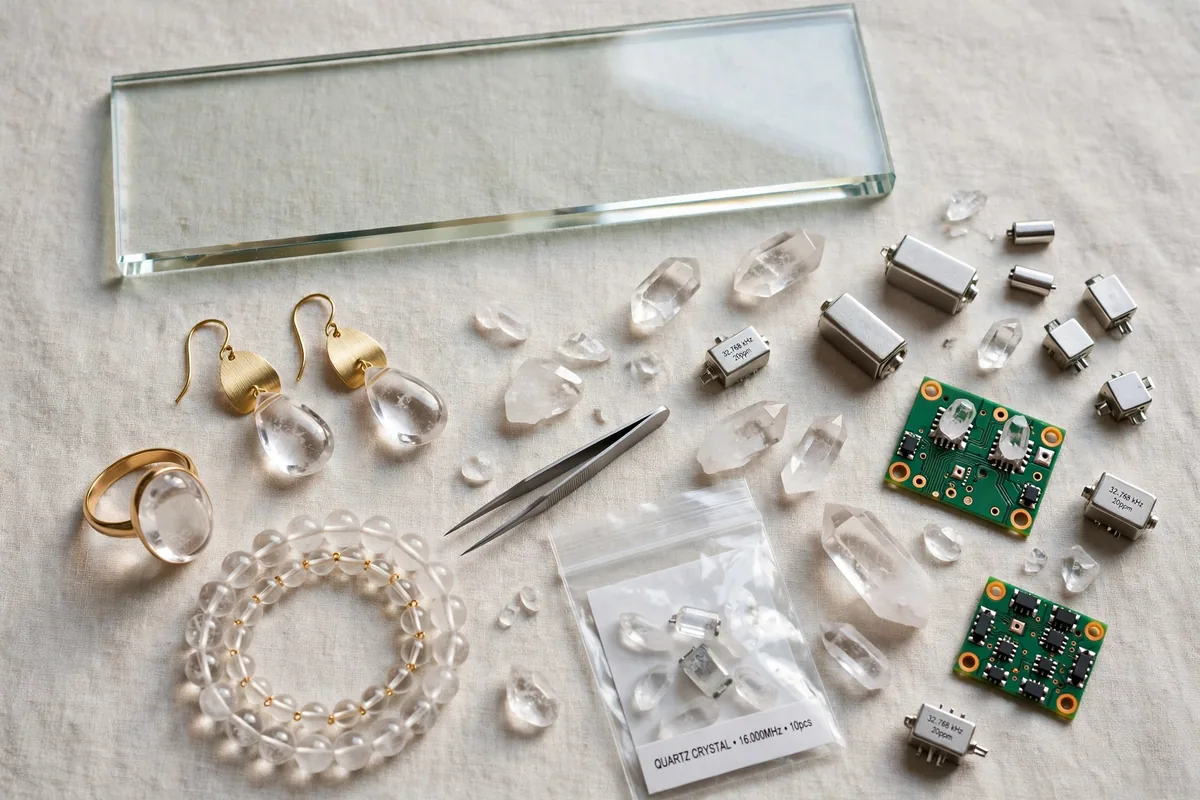
Once you start listing quartz’s jobs, the list gets long. Here are the heavy hitters:
Glass and ceramics. Sand – mostly quartz – is the primary raw material for glass, melted with soda ash and limestone. It is also a standard ingredient in porcelain, brick, cement, and mortar.
Electronics and timekeeping. Quartz oscillators regulate frequencies in watches, clocks, radios, and computers. The same piezoelectric stability keeps communication equipment on frequency.
Semiconductors and solar. High-purity quartz is refined into metallurgical-grade silicon, the starting point for computer chips and solar panels. Only exceptionally pure deposits qualify, which is why high-purity quartz commands a premium far above ordinary sand.
Abrasives and cutting. Quartz sand and crushed quartz go into sandpaper, sandblasting media, sawing and grinding compounds, and waterjet cutting abrasives.
Foundry and construction. Foundry sand (for metal casting molds), hydraulic fracturing proppant (sand pumped into wells to hold fractures open), filtration media, and concrete aggregate all run on quartz.
Gemstones and ornamental stone. Amethyst, citrine, rose quartz, smoky quartz, agate, and jasper are cut for jewelry and carvings – the same mineral, dressed up.
Engineered quartz surfaces. Kitchen countertops sold as “quartz” are typically around 90 percent ground natural quartz bound with resins. They are popular for a reason, and they have real trade-offs:
| Pros | Cons |
|---|---|
| Very hard and scratch-resistant for daily kitchen use | Not as heat-proof as natural stone – hot pans can damage the resin |
| Non-porous, so it resists staining without sealing | Can look uniform or “manufactured” compared with natural stone veining |
| Consistent color and pattern, slab to slab | UV exposure can discolor it over time, so it is an indoor material |
| Low maintenance – no annual sealing needed | Usually pricier than laminate and some granites |
Quartz vs. Look-Alike Minerals
New collectors and curious homeowners mix quartz up with a few common impostors. Here is how to tell them apart without a lab:
| Mineral | How to tell it from quartz |
|---|---|
| Glass (man-made) | Glass often holds tiny round bubbles; quartz never does. Glass is softer – a steel file scratches glass but not quartz. |
| Calcite | Calcite is much softer (Mohs 3) and splits along perfect cleavage planes; a drop of weak acid fizzes on calcite but does nothing to quartz. |
| Feldspar | Feldspar shows two directions of cleavage and a blockier look; quartz shows none and breaks in curved fractures. |
| Topaz or beryl (gemstones) | Both are harder or similarly hard; the honest answer is that cut stones need a gemologist – color alone proves nothing. |
The classic field test is the scratch test: if the specimen scratches window glass and a steel nail cannot scratch the specimen, quartz is the leading candidate. Combine that with the glassy luster and the absence of cleavage, and you are usually right.
Looking After Quartz
Quartz is low-maintenance, but a few habits keep it looking its best. Jewelry set with amethyst, citrine, or rose quartz should be kept out of prolonged direct sunlight – strong UV can slowly fade the color over months and years. Clean pieces with warm water, mild soap, and a soft cloth; ultrasonic cleaners are generally fine for plain quartz but risky for heavily included stones or anything with surface treatments.
For engineered quartz countertops, the rules are simple: use a trivet or pad under hot pots, wipe spills reasonably promptly even though the surface resists staining, and skip harsh scouring pads that can dull the finish. Amethyst geodes and crystal clusters displayed as decor just need an occasional dusting – a soft brush reaches into crevices that a cloth cannot.
Quartz Through History
Humans have worked quartz for as long as there have been humans. Flint – a form of microcrystalline quartz – was knapped into cutting tools and arrowheads in the Stone Age, and quartz crystal beads and carvings turn up in ancient Egyptian, Greek, and Chinese artifacts. The word “quartz” itself comes from the German “Quarz,” a term miners used centuries ago, though its deeper origin is debated.
Quartz also earned a place in early science. Long before anyone understood piezoelectricity, natural philosophers prized clear rock crystal for lenses and ornaments – the “crystal balls” of folklore were usually carved quartz. In the 19th century, quartz became a workhorse of mineralogy classrooms because it demonstrates so many textbook properties in one specimen: hardness, fracture, luster, and crystal form. When the Curies showed in 1880 that squeezing quartz produces electricity, the mineral moved from the museum shelf into the machine age – a transition that continued straight through the quartz-watch revolution of the 1970s and into the silicon chips of today.
Frequently Asked Questions
Is quartz a rock or a mineral?
Quartz is a mineral with the chemical formula SiO2. Many rocks contain quartz – granite and sandstone among them – but quartz itself is a single mineral, not a rock.
Why does quartz come in so many colors?
Trace impurities and natural radiation change how the crystal absorbs light. Iron plus irradiation makes amethyst purple; different iron chemistry makes citrine yellow; irradiation of aluminum-bearing quartz makes smoky quartz brown. Pure quartz is colorless.
Is quartz rare?
Not at all. It is the second most abundant mineral in Earth’s continental crust and one of the most common minerals on the planet. What varies is quality – large flawless crystals, deep-colored amethyst, and ultra-high-purity quartz are far less common than ordinary quartz sand.
Is quartz valuable?
Ordinary quartz is cheap – sand is sand. Value appears at the extremes: fine amethyst and collector-grade crystal specimens, and high-purity quartz refined for semiconductors and optics, where purity specifications make the material worth far more than its weight in beach sand.
What is the difference between quartz and quartzite?
Quartz is the mineral; quartzite is a metamorphic rock made almost entirely of quartz grains fused together by heat and pressure. Think of it as sandstone that got cooked until its quartz grains welded into a single hard mass.
Can quartz be man-made?
Yes. Synthetic quartz is grown hydrothermally in laboratories and is chemically identical to natural quartz. Most of the quartz crystals used in electronics today are cultured this way because lab-grown crystals can be made more uniform than natural ones.
Reead Also: Water Tower Water Tower: How These Giant Tanks Work (2026 Guide)
#quartz #minerals #science

Related Articles
Lucipara: Indonesia Banda Sea Islands Guide (2026)
Lucipara most often means the remote Lucipara Islands in Indonesia's Banda Sea, a small atoll group…
Carnauba Wax (2026 Guide): What It Is, Uses, Types, and How to Use It Safely
Carnauba wax is a natural plant wax known for its hard finish and high shine. This…
Blue Is a Hot Color: Why Blue Is Everywhere Right Now
Why is blue a hot color right now? The science of our attraction to blue, the…