Lucipara: Indonesia Banda Sea Islands Guide (2026)
Lucipara most often means the remote Lucipara Islands in Indonesia's Banda Sea, a small atoll group known for sea turtles, steep reef drop-offs, and very few visitors.

Lucipara: Indonesia Banda Sea Islands Guide (2026)
Search for lucipara and you will meet a puzzle before you meet a place. The word appears in a handful of very different contexts, and some of the pages that use it are vague, poetic, or plainly invented. The solid, checkable meaning, and the one that explains most serious references, is geographic: Lucipara is a small, remote group of islands in the Banda Sea, in eastern Indonesia. Divers, sailors, and marine conservationists know the name, while most other travellers have never heard it, which is exactly why it keeps its wild character.
This guide leads with that real place, because it is the meaning a reader can verify on a map and in travel and conservation writing. It also clears up the other uses of the word, briefly and honestly, so you are not misled by pages that treat lucipara as a mystical force, a festival, or a cure. There is no reliable evidence for those grander claims, and this article does not repeat them as fact. What Lucipara does offer, on the evidence available, is something rarer: a barely inhabited atoll in deep ocean water, famous for sea turtles, steep coral walls, and the feeling of being a long way from anywhere.
If you came here looking for a holiday idea, a geography answer, or simply the meaning of an unfamiliar word, start with the islands. They are small, hard to reach, and ecologically important, and they reward the kind of traveller who prefers a boat, a mask, and patience over a resort and a schedule.
In this article:
- What lucipara means
- Where Lucipara is
- The islands themselves
- Why divers and snorkellers talk about Lucipara
- Wildlife and the marine environment
- History and local claims
- Getting there and when to go
- What a visit really involves
- Conservation and responsible visiting
- Pros and cons of visiting Lucipara
- Frequently asked questions
What Lucipara Means
Key: dominant meaning. Lucipara, also written Lucipara Islands, is a small atoll group in the Banda Sea, Indonesia, also known as Pulau-pulau Maisel and by older spellings including Lucepara.
Key: location in brief. About 50 kilometres west of the Penyu Islands, south of the Manipa Strait near Ceram, in the Maluku Islands.
Key: inhabited. No permanent settlement today, though families with traditional claims return at times, including to harvest coconuts.
Key: best known for. Sea turtles, coral reefs, steep drop-offs, and remote diving and snorkelling.
The name itself is not a common English word, and it does not have a dictionary definition in the way that a word like island does. Its meaning comes from the place it names. Older accounts spell it differently: Edmund Roberts, an American diplomat who visited briefly in the 19th century, called the islands Lucepara in his 1832 journal, published in 1837. Other variants that appear in sailing and diving writing include Lucapin, Lusipari, and Lousapara, which reflects the way a remote place name can shift between languages, charts, and local usage. None of those spellings points to a different place; they are the same small group, seen from different charts and traditions.
Two other uses deserve a short, clear note, because they cause confusion. First, Euplexia lucipara is the scientific name of a moth, the Small Angle Shades, found in Europe and elsewhere. The second part of its Latin name is a species label, not a place, and it has nothing to do with the Indonesian islands beyond sharing a word. Second, some recent web pages present lucipara as a spiritual concept, a glowing phenomenon, or a traditional festival, often with no sources, dates, or places attached. Those pages read like invented content built around a keyword, and they should not be treated as evidence about a real tradition. When a claim has no verifiable place, people, or history behind it, the honest response is to say so, rather than to dress it up as folklore.
Where Lucipara Is
Lucipara sits in the middle of the Banda Sea, in the Maluku province of Indonesia. The Banda Sea is a deep basin between larger Indonesian islands, known for volcanic islands, deep trenches, and strong ocean currents. Within that sea, Lucipara lies southwest of the Penyu Islands and northeast of Skaro Reef, and roughly south of the Manipa Strait near Ceram, also spelled Seram. Some sailing accounts describe the group as about 200 kilometres south of Ambon, the main city and port of the region, while fishing accounts put the sailing distance from Ambon at roughly 175 kilometres. The difference reflects different departure points and routes, not a different destination: by any measure, this is a long way offshore.
The broader setting helps to explain why the islands feel so isolated. The Banda Islands, famous in history for the spice trade, lie to the east. Ambon lies to the north. Between them stretches open sea, broken only by small atolls and submerged reefs. Lucipara is one of those interruptions: a place where undersea mountains rise steeply enough to break the surface as low, green islands, surrounded by lagoons and then by deep water. Some diving writing describes the atolls as the tops of undersea mountains rising more than a mile from the ocean floor, a vivid image that captures the suddenness of the place: shallow reef, then a wall, then open ocean.
For a reader who wants a simple mental map, think of eastern Indonesia, then of the Banda Sea in its middle, then of a tiny cluster well away from the main shipping and tourist routes. That remoteness is not an accident of this guide’s emphasis. It is the central fact about Lucipara, shaping its wildlife, its history, and every practical question about visiting.
The Islands Themselves
The Lucipara Islands are an atoll made up of three main islands: Pulau Selatan, Pulau Kaurangka, and Pulau Mai. Different sailing accounts divide the group slightly differently, sometimes speaking of five small islands or six islands with fringing atolls, depending on whether small sand cays and reef islets are counted. The core point is consistent: this is a very small group, not a large archipelago, and the land area is tiny compared with the surrounding sea.
Pulau Mai carries particular local significance. Families who used to live on Pulau Mai are described as staking a traditional claim to the islands, returning at times to harvest coconuts. That detail matters, because it corrects a common romantic idea that remote islands are empty in every sense. Lucipara has no town, no permanent village, and no tourist infrastructure in the usual sense, but it is not outside human history or human claims. Fishers from Ambon and from further afield also visit, drawn by tuna and reef fish around the steep drop-offs and the lagoon of Skaro Reef nearby.
On land, the islands are low, green, and fringed by beaches that serve as turtle nesting sites. A lighthouse, staffed in rotations, is one of the few signs of permanent human presence described by visitors. Inland, there is little to do in the conventional tourist sense: no roads to explore, no markets, no hotels. The experience of Lucipara is almost entirely a marine one, lived from a boat, on a beach at sunset, or under the water along a reef wall.
Why Divers and Snorkellers Talk About Lucipara
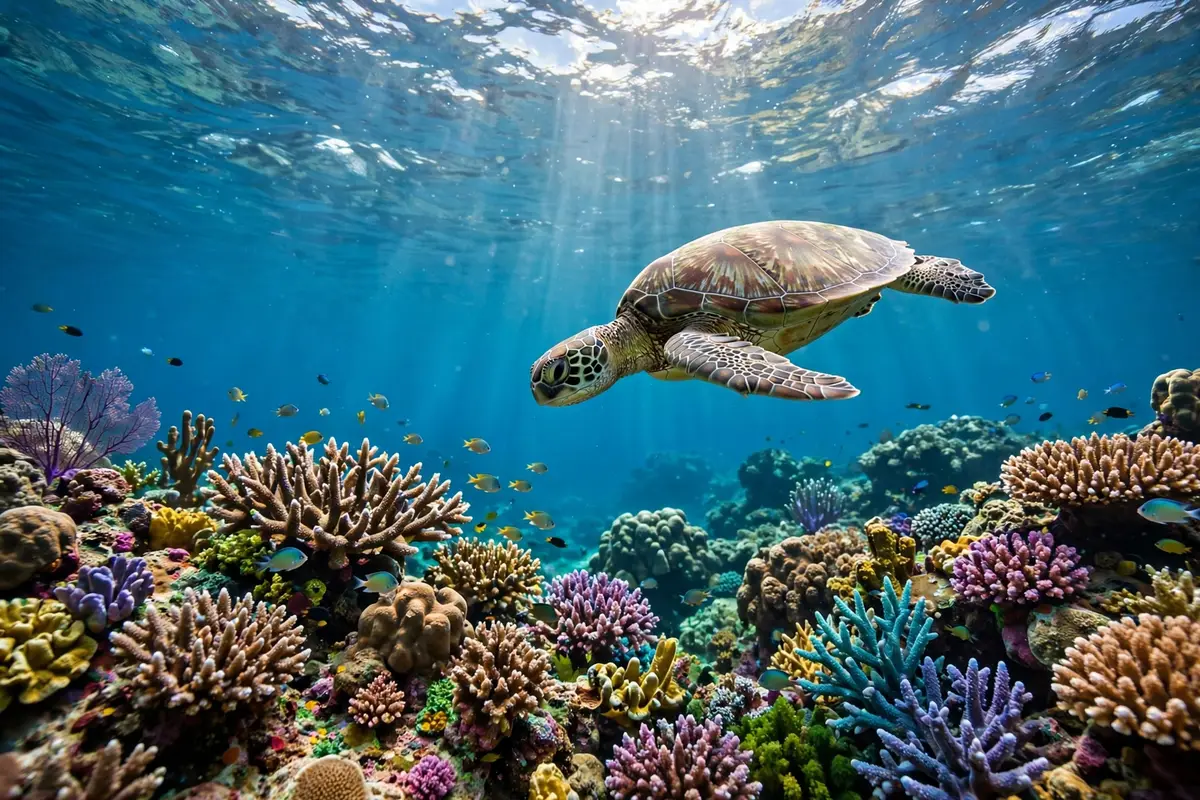
Divers talk about Lucipara for a simple reason: the combination of remoteness, clear water, and steep reef structure is rare. The reefs fringe the islands, then drop sharply into deep water, creating walls where coral, reef fish, and larger pelagic species meet. Snorkellers can enjoy the shallow reef flats and the warm, shallow water over the flats at low tide, while divers can work the walls and drop-offs where the reef gives way to open sea.
Accounts from diving and sailing trips describe huge schools of unicornfish and surgeonfish on the walls, colourful corals and bright orange anthias on the reef tops, and plenty of turtles, though turtles here can be shy, a reminder that they are still hunted in the region. Larger fish, including Napoleon wrasse, red emperor, trevally, and various tuna, are part of the attraction for both divers and sport fishers. Night diving has a particular draw: the rare flashlight fish, Photoblepharon bandanensis, associated with the Banda Sea, is mentioned in diving writing about the area as a special night-diving sight.
None of this makes Lucipara an easy dive destination. Currents, depth, and distance from help demand experience, good planning, and a capable boat and crew. The rewards are not the manicured reefs of a resort dive centre, but the wilder, less predictable encounters of a remote atoll: a wall that falls away into blue, a school that parts around a diver, a turtle gliding over coral that has had little human disturbance. For divers who have already explored the better-known Indonesian sites, that is precisely the appeal.
Wildlife and the Marine Environment
The Lucipara Islands are famous, above all, for their sea turtle population. Green turtles nest on the uninhabited beaches, and turtles are a constant presence in the surrounding water. That fame is also a conservation concern, because nesting beaches and feeding grounds are sensitive, and because turtles in the region face hunting pressure as well as the wider threats of habitat loss and climate change. Visitors who keep a respectful distance, avoid touching or chasing turtles, and stay off nesting beaches at night are doing the minimum that the place asks of them.
The coral story is mixed in a way that is honest to report. Field findings reported in marine protected area discussions describe coral reef conditions ranging from damaged to very good, alongside a high abundance of sea turtles and sharks. That range is normal for a remote area that is visited by fishers and divers but not managed as a resort: some reefs thrive, others show damage, and the overall system remains rich. Deep-sea features around the islands, including submerged reefs, seamounts, submarine canyons, and trenches, add to the ecological value, and the area is noted for cetacean habitat and regional ecological connectivity in the Banda Sea. Blue whales have been observed in the wider Banda Sea region, though seeing one near Lucipara itself is a matter of luck and season, not a promise.
For readers who like everyday science explainers, the general guides on 9bio and DailyOrvix cover natural topics in plain language, and they are a good next step after a place as specific as Lucipara. The science here is not abstract: it is about how a tiny atoll in deep water can support turtles, sharks, reef fish, and passing whales, and how easily that balance can be disturbed by too much fishing, too much anchoring, or too many visitors at once.
History and Local Claims
Lucipara’s history is quiet compared with the dramatic spice-trade history of the nearby Banda Islands, but it is not blank. The islands appear in 19th-century travel writing, they served as a navigational reference for ships crossing the Banda Sea, and they carry the story of a shipwreck that gave the name a second life. In 1837, the Dutch steamer Willem I was wrecked in the area, and its passengers and crew, including the governor of the Moluccas and his family, found refuge on the tiny Lucipara islands. They waited more than a month for rescue, and shortly after rescue, a daughter was born who was given Lucipara as part of her name. The story is retold by a sailing project that kept the name Lucipara for its boat, and it is a reminder that a remote place can enter family history in unexpected ways.
The more important history, for anyone thinking about the islands today, is the local one. The claim staked by families formerly living on Pulau Mai, the periodic coconut harvests, and the fishing visits from Ambon and Wakatobi all show that Lucipara is part of a living seascape, not a wilderness without people. Modern conservation work reflects that reality. The islands have been allocated within the Maluku Provincial Spatial Plan, covering a large marine area, and multi-stakeholder discussions have worked toward a marine protected area, with a management roadmap running to 2028. That process involves government, conservation organisations, and local stakeholders, and it aims to balance protection with well-managed marine tourism and fisheries, rather than to close the area off entirely.
Getting There and When to Go
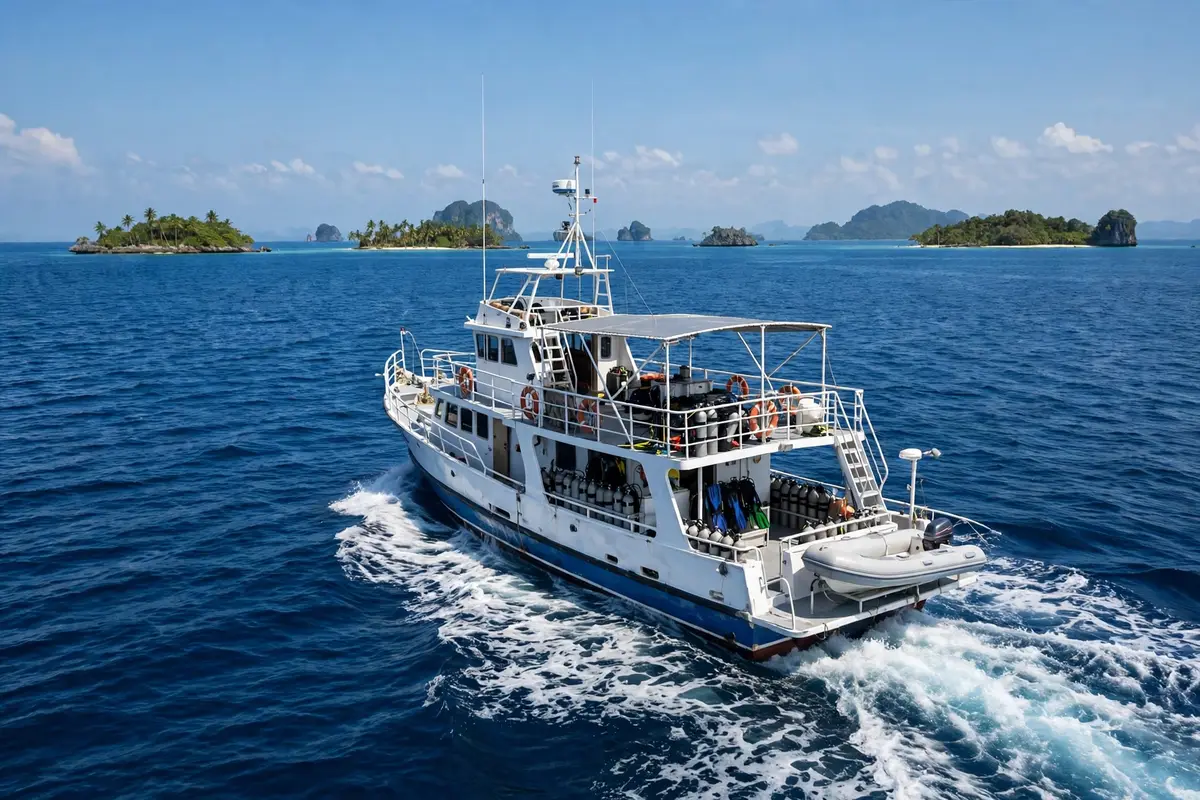
There is no airport on Lucipara, no regular ferry, and no hotel to book. The normal route is by liveaboard boat or chartered vessel from Ambon, with flights into Ambon from Bali or Jakarta, often via Makassar. Sailing accounts put the Ambon to Lucipara crossing at roughly 14 to 15 hours, and the islands can only be reached by boat during a few months of the year, when sea conditions allow, particularly around the change of the monsoon. That window is the single most important practical fact about a visit: Lucipara is not a place to add casually to a short trip.
Diving sources often give October to December and March to April as favourable periods, which fits the pattern of calmer inter-monsoon seas in the region. Even within those windows, conditions can change, and a responsible operator will adjust plans for weather, currents, and safety rather than forcing a schedule. Travellers should therefore treat any itinerary that promises Lucipara on a fixed date as provisional, and should choose an operator with experience in remote Banda Sea sailing, not simply the cheapest boat available.
Costs, group sizes, and exact schedules vary by operator and by year, so this guide does not quote prices or promise departures. The honest summary is that a Lucipara trip is a specialist expedition, usually part of a longer Banda Sea liveaboard itinerary that also visits other remote islands, rather than a standalone weekend break. That is part of its charm, and part of its cost.
What a Visit Really Involves
A Lucipara visit is lived from a boat. Days are shaped by diving and snorkelling, by meals on deck, by sunset walks on uninhabited beaches, and by the slow rhythm of a liveaboard far from shore. There are no restaurants, shops, or day trips to book, and phone signal and internet, where they exist at all, are unreliable. For some travellers, that disconnection is the point. For others, it is a reason to choose a different Indonesian destination, and that is a sensible decision.
Practical preparation matters more than packing lists. Bring reef-safe sun protection, a good mask and fins if you have them, and any medication you need, because there is no pharmacy nearby. Respect the boat crew’s briefings on currents, entry and exit points, and wildlife encounters. Do not stand on coral, do not collect shells or coral, and do not approach nesting turtles. If you fish, do so only where it is permitted and with a licensed operator, and be aware that the conservation direction for the area is toward managed, sustainable use, not open exploitation.
Health and safety planning should be taken seriously. Remote diving means a longer journey to medical help, so divers should be fit, insured for diving and evacuation, and honest about their experience level. Non-divers can still enjoy snorkelling, beach walks, and wildlife watching from the boat, but they should be comfortable with long sea crossings and simple living conditions. Lucipara rewards self-sufficiency and patience; it does not reward a fixed, resort-style expectation.
Conservation and Responsible Visiting
The direction of travel for Lucipara is toward formal protection. The islands have been identified for marine protected area management, and discussions among government, conservation groups, and stakeholders have set out a roadmap that includes designating the area, building management capacity, developing sustainable funding, and mapping stakeholders and social dynamics. That process recognises what visitors sometimes miss: conservation here is not only about coral and turtles, but about who has claims, who fishes, and who benefits from tourism.
Responsible visiting, in that context, is straightforward. Choose operators who respect local rules and who contribute to local management, rather than those who treat the islands as an unregulated playground. Keep groups small, waste minimal, and anchoring careful. Leave beaches as you found them. Support the idea that a remote place can be visited without being consumed, and that its value lies partly in remaining remote. If a future visit becomes easier, cheaper, and more crowded, something important will have been lost, even if more people get to see it.
Pros and Cons of Visiting Lucipara
| Aspect | Advantage | Drawback |
|---|---|---|
| Remoteness | Very few visitors, wild reefs, and a genuine sense of discovery | Long boat journey, limited season, and no infrastructure |
| Wildlife | Sea turtles, sharks, reef fish, and possible cetaceans | Sightings are never guaranteed, and turtles can be shy |
| Diving | Steep walls, clear water, and healthy reef tops | Currents and depth demand experience and careful planning |
| Culture | Local claims and a 19th-century shipwreck story add depth | No villages, museums, or tourist facilities to visit on land |
| Conservation | Moving toward marine protected area status | Some reefs show damage, and management is still developing |
Frequently Asked Questions
What is lucipara?
Lucipara most reliably means the Lucipara Islands, a small atoll group in the Banda Sea, Indonesia, known for sea turtles, coral reefs, and remote diving. The word also appears as part of a moth’s scientific name, Euplexia lucipara, which is unrelated to the islands.
Where are the Lucipara Islands?
They are in the Banda Sea, in Maluku province, Indonesia, southwest of the Penyu Islands and northeast of Skaro Reef, south of the Manipa Strait near Ceram, roughly 175 to 200 kilometres by sea from Ambon, depending on the route.
Are the Lucipara Islands inhabited?
There is no permanent settlement today, but families with traditional claims, particularly linked to Pulau Mai, return at times, including to harvest coconuts, and fishers visit the surrounding waters. A lighthouse is staffed in rotations.
How do you get to Lucipara?
By liveaboard boat or chartered vessel from Ambon, usually as part of a longer Banda Sea itinerary. The crossing takes roughly 14 to 15 hours, and access is limited to calmer sea periods, often around the monsoon changes.
When is the best time to visit Lucipara?
Diving sources often point to October to December and March to April, when seas are calmer. Conditions vary by year, so any plan should remain flexible and follow the operator’s safety advice.
Is Lucipara good for diving?
Yes, for experienced divers and snorkellers. The reefs offer walls, drop-offs, healthy coral tops, and abundant fish and turtles, but currents, depth, and remoteness require experience, good equipment, and a capable crew.
Is Lucipara a marine protected area?
It is moving in that direction. The islands have been allocated in the Maluku Provincial Spatial Plan and are the subject of multi-stakeholder work toward marine protected area management, with a roadmap running to 2028. The exact status should be checked with current local sources before a visit.
Why do some websites describe lucipara differently?
Some recent pages use the word for invented spiritual, festival, or glowing-phenomenon claims without verifiable sources. Those should be treated with caution. The verifiable meaning is the islands, plus the unrelated moth name.
Read Also: 316 Area Code: Wichita, Kansas Complete Guide (2026)

Related Articles

Carnauba Wax (2026 Guide): What It Is, Uses, Types, and How to Use It Safely
Carnauba wax is a natural plant wax known for its hard finish and high shine. This…

Blue Is a Hot Color: Why Blue Is Everywhere Right Now
Why is blue a hot color right now? The science of our attraction to blue, the…

Quartz (2026 Guide): What This Common Mineral Is, Its Properties, Types & Uses
Everything you need to know about quartz - the silicon dioxide mineral behind glass, gemstones, and…
1 Comment