The Black Phone: Plot, Ending Explained, Cast & Black Phone 2 Sequel Guide (2025)
The Black Phone: Everything You Need to Know About Blumhouse’s 2022 Horror Hit
There’s a particular kind of phone call nobody wants to get — the one from a number that’s been disconnected for years. In The Black Phone, that call comes from a black rotary phone bolted to a basement wall, and the voices on the other end belong to dead kids. It’s a simple, nasty premise, and it’s exactly why the movie worked.
Released in the summer of 2022, The Black Phone became one of those rare horror movies that horror fans, casual viewers, and critics all agreed on. Directed by Scott Derrickson — the filmmaker behind Sinister and Marvel’s Doctor Strange — and starring Ethan Hawke in a career-left-turn role as a child abductor known only as The Grabber, it turned a modest budget into a massive box office win and launched a franchise. Then, in October 2025, Black Phone 2 picked the story back up.
This guide covers everything: what the movie is about, the ending explained (with a clear spoiler warning first), who The Grabber really is, whether it’s based on a true story, the cast, the Joe Hill short story it came from, how the sequel fits in, and where you can watch it.

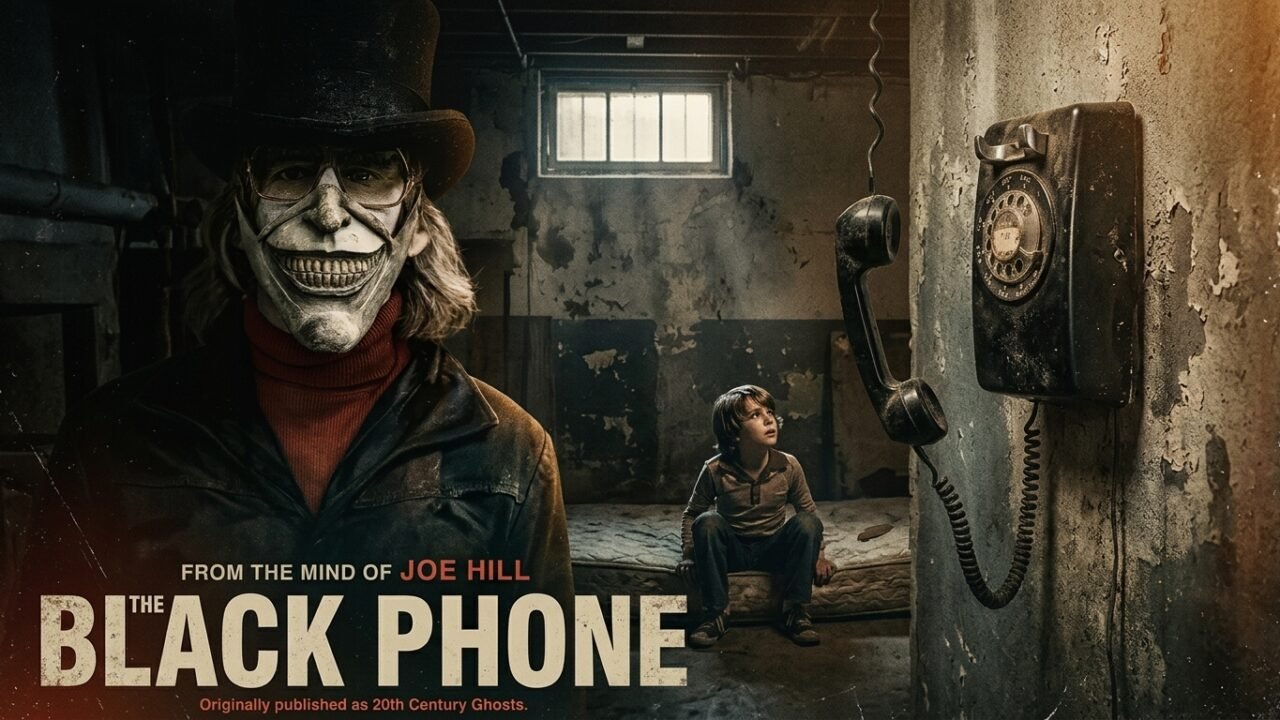
The black rotary phone on the basement wall — the movie’s central image and the strangest plot device in recent horror.
What Is The Black Phone About?
Short answer: The Black Phone is a supernatural horror film about Finney Blake, a shy 13-year-old boy who is kidnapped by a masked serial killer called The Grabber and locked in a soundproof basement. The only thing in the room besides a mattress and a toilet is an old black rotary phone that doesn’t work. Except it starts ringing — and the callers are the ghosts of The Grabber’s previous victims, each one passing Finney a piece of the plan that could get him out alive.
It’s a ghost story and a kidnapping thriller at the same time. The horror isn’t really about jump scares, though there are a few good ones. It’s about dread: a kid in a room, a killer upstairs, and a phone that keeps ringing with advice from children who didn’t make it.
Here are the fast facts:
| Detail | Fact |
|---|---|
| Title | The Black Phone |
| Release date | June 24, 2022 (US theatrical) |
| Director | Scott Derrickson |
| Writers | Scott Derrickson & C. Robert Cargill |
| Based on | The short story “The Black Phone” by Joe Hill (2004) |
| Studio | Blumhouse Productions / Universal Pictures |
| Runtime | 103 minutes |
| Rating | R — for violence, bloody images, language, and drug use |
| Setting | 1978, a suburb of Denver, Colorado |
| Budget | $16–18 million |
| Box office | Approximately $161 million worldwide |
| Sequel | Black Phone 2 (released October 17, 2025) |
The Plot: What Actually Happens
Spoiler warning: This section and the next one describe the full story, including the ending. If you haven’t watched the movie yet, skip ahead to “Who Is The Grabber?”
It’s 1978. In a quiet Denver suburb, kids are disappearing. The local papers call the abductor The Grabber, and nobody knows what he looks like. Finney Blake is a thoughtful, soft-spoken 13-year-old who gets bullied at school, lives with his tough younger sister Gwen and their alcoholic father, and is quietly brave in the way real shy kids often are.
One afternoon, walking home, Finney is grabbed — a man in a van, a trick, a struggle — and wakes up in a concrete basement. The room is nearly empty. On the wall hangs a black rotary phone. The Grabber tells him it’s disconnected. It has been for years.
Then it rings.
The callers introduce themselves one by one: Bruce, Billy, Griffin, Vance, Robin. Each is a boy The Grabber took before Finney. Each has tried to escape and failed, and each one passes along the single thing they learned — a loose floor tile, a combination to a lock, a spot in the wall where a cable runs. No single ghost has the whole answer. Together, they’re building Finney an exit plan from beyond the grave.
Meanwhile, above ground, Gwen is having vivid dreams — visions, really — that keep leading her closer to where Finney is being held. She’s the movie’s second engine: while Finney fights from inside the basement, Gwen fights from outside it, dragging a skeptical police force and her own fear along with her.
The Ending Explained
The ending is really a heist assembled from spare parts. Every failed escape attempt by the dead boys becomes one piece of Finney’s plan: he digs where they tell him to dig, rigs the phone cord where they tell him to rig it, and when The Grabber finally comes downstairs for the kill, Finney is ready.
The final confrontation flips the movie’s power dynamic in one clean motion. The Grabber, who has spent the whole film as the thing in the dark, suddenly finds himself caught in a trap built out of his own victims’ knowledge. The ghosts taunt him over the phone — the sound he used to terrorize them, turned back on him — and Finney finishes it. He gets out, reunites with Gwen, and walks back into his life a different kid than the one who was taken.
What makes the ending land isn’t the mechanics, though. It’s the theme the movie has been quietly building: the dead boys couldn’t save themselves, but they refused to let the next kid die the same way. Finney doesn’t survive because he’s the strongest or the smartest. He survives because five dead kids decided he was worth more effort than they got. That’s the emotional punch, and it’s why people walked out of theaters talking about this one instead of the dozen other horror releases that summer.

1978 suburban Denver: quiet streets, kids on bikes, and a black van that doesn’t belong.
Who Is The Grabber?
The Grabber is the film’s killer — a sadistic child abductor operating in 1978 suburban Denver — and he’s one of the more unsettling horror villains of the last decade, precisely because he doesn’t look like a movie monster.
Ethan Hawke plays him, and it’s a genuine against-type performance. Hawke spent most of his career as the thoughtful, romantic lead (Before Sunrise, Dead Poets Society, Training Day). Here he’s unrecognizable behind a series of masks with detachable pieces — the mask changes depending on his mood, which is somehow worse than a fixed face. The masks were designed by horror effects legend Tom Savini, whose credits run from Dawn of the Dead to Friday the 13th.
What makes The Grabber frightening isn’t supernatural power. He’s just a man — theatrical, childish, prone to tantrums, and completely without conscience. He leaves the basement door unlocked as a game. He plays with his victims the way a bored kid plays with insects. Hawke plays him with an unstable, almost playful energy that keeps you off balance: one minute he’s goofy, the next he’s terrifying, and you never know which version is walking down those basement stairs.
The film deliberately keeps his backstory thin. You don’t get a tragic origin or a psychology lecture. He’s evil the way a shark is dangerous — the movie is about the kids, not him, and that restraint is one of its smartest choices.
Is The Black Phone Based on a True Story?
No. The Black Phone is fiction — it’s adapted from a short story by Joe Hill, who happens to be Stephen King’s son. There is no real Grabber, no real Finney Blake, and no documented case of a haunted disconnected phone saving a kidnapping victim.
That said, the movie feels true in a way that matters, and that’s not an accident. Director Scott Derrickson grew up in suburban Denver in the 1970s, and he built the film’s world out of his own childhood memories — the clothes, the houses, the music, the particular boredom and freedom of being a kid in that era. The late-70s setting also taps into a very real cultural memory: that was the decade when America started to realize that the suburbs weren’t as safe as they looked, the era of milk-carton kids and stranger-danger warnings.
So while the ghosts and the phone are pure invention, the fear underneath them — that the quiet street you grew up on might be hiding something — is drawn from something real. Derrickson has talked about horror as a way of confronting the frightening things in the world, and you can feel that personal stake in every frame.
Meet the Cast
The movie belongs to its young leads, and the casting is a big part of why it works:
- Mason Thames as Finney Blake — Thames was a newcomer, and he carries nearly half the movie alone in a basement. His performance is quiet rather than showy: you watch a scared kid think his way through an impossible situation, and it never feels like acting.
- Madeleine McGraw as Gwen Blake — Gwen is the breakout character, and McGraw is phenomenal. She’s foul-mouthed, funny, devout in her own way, and ferociously loyal to her brother. Her scenes — especially a showdown with a school principal — are the movie’s emotional highlights.
- Ethan Hawke as The Grabber — Hawke’s first real villain role, and he commits completely. The shifting masks do half the work; his voice and body language do the rest.
- Jeremy Davies as Terence Blake — Finney and Gwen’s father, an alcoholic struggling after his wife’s death. Davies (known from Saving Private Ryan and Justified) makes him flawed without making him a villain.
- James Ransone as Max — The Grabber’s coke-addled brother, living upstairs, slowly putting the pieces together. Ransone brings unexpected humanity to a small role.
- Miguel Cazarez Mora as Robin — Finney’s friend, the tough kid who stood up to bullies for him. His ghost delivers the final piece of the escape plan.
The Short Story Behind the Film
The Black Phone began as a short story by Joe Hill, first published in 2004 and later collected in his acclaimed 2007 anthology 20th Century Ghosts. Hill — who spent his early career publishing under a pseudonym so he wouldn’t trade on his father’s famous name — wrote a lean, mean little story: a kidnapped kid, a basement, a disconnected phone, and the voices of the dead.
Derrickson and his longtime writing partner C. Robert Cargill (the team behind Sinister) expanded that roughly 30-page story into a two-hour film. The expansion is mostly character work: the short story is all basement, but the film adds Gwen and her visions, the family backstory, the 1978 setting, and the neighborhood texture. The ghosts calling with escape advice is straight from Hill; the emotional world around it is the filmmakers’ invention.
If you like the movie, the story is worth tracking down — it’s a quick read, and it’s interesting to see how much of the film’s DNA was already there on the page.
Why The Black Phone Worked: Reception and Box Office
Horror is a genre where critical praise and audience love don’t always overlap. The Black Phone got both. It premiered at Fantastic Fest in September 2021 to strong buzz, then opened theatrically in June 2022 — an unusual summer slot for a horror film — and outperformed expectations from its first weekend.
The numbers tell the story: made for roughly $16–18 million, it grossed about $161 million worldwide. That’s nearly a 10x return, the kind of result that makes studios greenlight sequels. Critics praised Hawke’s performance, the young cast, and Derrickson’s confident direction; audiences scored it even higher, landing it in the high 80s on Rotten Tomatoes on the audience side.
But the deeper reason it connected is thematic. Most horror movies are about surviving the monster. The Black Phone is about what the victims do for each other — and it’s really a coming-of-age story wearing a horror costume. Finney starts the film unable to stand up to a school bully. He ends it having out-thought a serial killer. That’s an arc people remember, and it’s why the movie has stuck around in the culture instead of fading like most mid-budget horror.
Black Phone 2 (2025): The Sequel
Yes, there’s a sequel — and it’s already out. Black Phone 2 was released theatrically on October 17, 2025, after premiering at Fantastic Fest that September.
Here’s what you need to know:
- The team returned: Scott Derrickson directed again, co-writing with C. Robert Cargill, with Jason Blum producing.
- The cast is back: Mason Thames and Madeleine McGraw return as Finney and Gwen, Ethan Hawke returns as The Grabber, and Jeremy Davies is back as their father. New additions include Demián Bichir.
- The story jumps forward: Set four years after the first film, Finney is now 17 and still dealing with what happened to him. This time, it’s Gwen at the center of the supernatural activity — she’s receiving terrifying calls in her dreams, visions of boys being stalked at a remote winter youth camp called Alpine Lake.
- The Grabber is back too: Death, it turns out, wasn’t the end of him. He’s returned more powerful and more sinister, haunting the camp and the siblings’ lives.
- Bigger in every way: The sequel runs 114 minutes, cost about $30 million to make, and grossed roughly $133 million worldwide — another solid commercial win. Reviews were generally positive, with critics noting it’s darker, more supernatural, and more focused on Gwen than the original.
The sequel shifts the formula in an interesting way: the first film is a basement movie, claustrophobic and contained. The second opens things up — snow, a camp, dream sequences shot with a grainy Super 8 texture — and leans harder into the mythology of the phone and the Grabber’s victims. If the original was about survival, the sequel is about aftermath: what living through something like that does to a kid, and to a family.

Alpine Lake: the snowbound winter camp at the center of Black Phone 2’s expanded mythology.
Where to Watch The Black Phone
Streaming rights rotate, so always check your region — but as a rule of thumb: The Black Phone has streamed on Peacock in the US (Universal’s home platform) and has been available to rent or buy digitally on services like Prime Video and Apple TV. Black Phone 2, being a recent theatrical release, is following the usual path from theaters to digital rental to streaming.
If you’re deciding between watching and rewatching before the sequel: the first film absolutely stands alone, but the sequel hits harder if you remember the basement. A double feature is the move.
Frequently Asked Questions
Is The Black Phone scary?
It’s tense more than gory. The horror comes from dread and atmosphere — a kid trapped in a basement with a killer upstairs — rather than constant jump scares or graphic violence. Most viewers find it frightening but not traumatizing, though the subject matter (child abduction) is inherently disturbing.
Is The Black Phone appropriate for kids?
It’s rated R for violence, bloody images, language, and drug use. Parents generally consider it suitable for teens around 14–15 and up, but the child-abduction premise makes it a “watch first yourself” situation for younger teens.
What is The Grabber’s real name?
The film never gives him one. He’s only ever called The Grabber, and the movie intentionally withholds his backstory. That anonymity is part of what makes him frightening.
Do the ghosts in The Black Phone actually call Finney?
Within the movie’s world, yes — the calls are real, not hallucinations. Gwen’s visions independently confirm the supernatural element, and the information the ghosts provide turns out to be accurate.
Is there a post-credits scene in The Black Phone?
No. Once the credits roll, the story is done. You can leave when they start.
Will there be a Black Phone 3?
Nothing has been officially announced. But with two profitable films and an expanding mythology around the phone and the Grabber’s victims, the door is clearly open.
Is Black Phone 2 scarier than the first one?
It’s darker and more supernatural, with a bigger emphasis on horror imagery and Gwen’s visions. Whether it’s “scarier” is subjective — the first film’s claustrophobic realism is hard to top — but most critics found the sequel a worthy, more ambitious follow-up.
Read Also: Michigan man $1m lottery After Two Words: “Why Not?”

Related Articles

Elliott Gould (Complete Guide): Life, Career, Films and TV Roles Explained
Elliott Gould went from 1970s leading man to beloved TV dad. This guide covers his life,…

DopeBox: What It Is, How It Works, and Whether It’s Safe & Legal (2026 Guide)
DopeBox: What It Is, How It Works, and Whether You Should Use It Somewhere between your…

Midsommar (2019) Explained: Plot, Ending, True Story & Filming Locations
Midsommar (2019): The Complete Guide to Ari Aster’s Daylight Horror Masterpiece Midsommar is a 2019 folk…