The James Webb Telescope and the New Era of Astronomy
Infrared eyes, a sunshield the size of a tennis court, and images that rewrote textbooks. The story of the most ambitious telescope ever built.
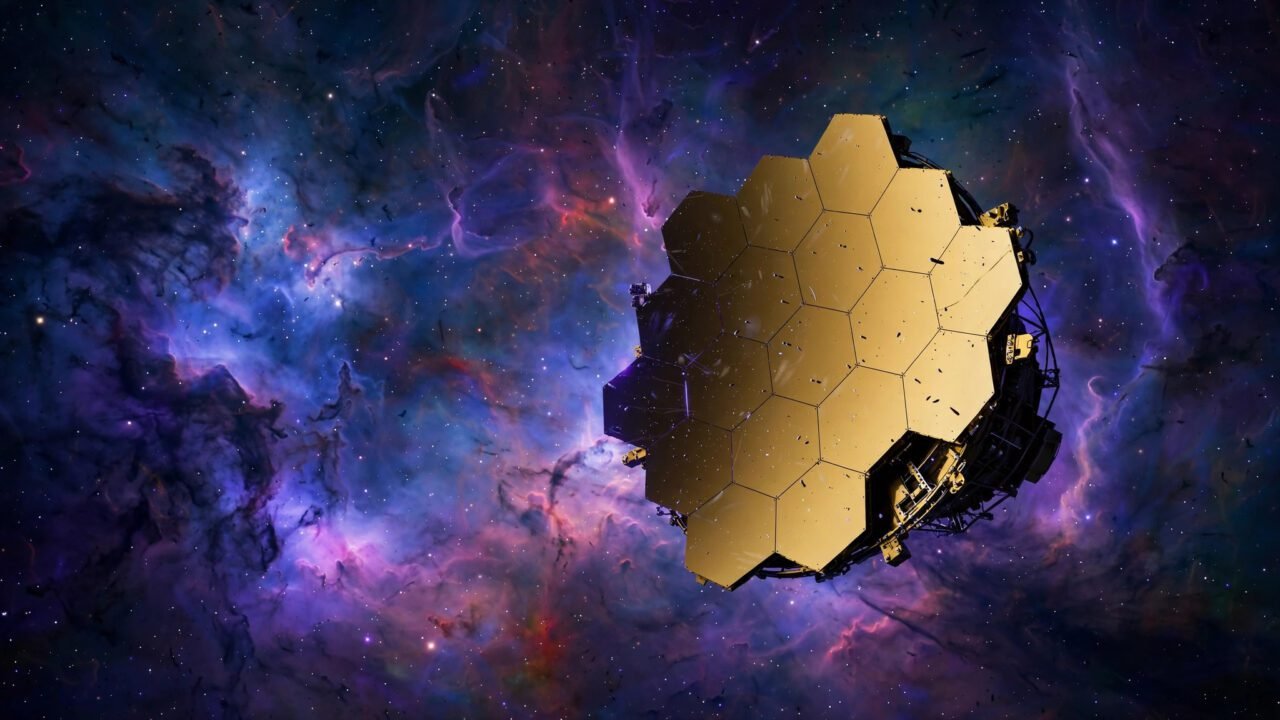
When the James Webb Space Telescope opened its golden eye, it did more than take prettier pictures of space. It let astronomers see further back in time than ever before, capturing light from the universe’s earliest galaxies, and it began reading the atmospheres of distant worlds. It is the most ambitious scientific instrument ever launched, and it is rewriting astronomy in real time. Billions of dollars, decades of work, and hundreds of heart-stopping deployment steps all came down to a single question: could we build a machine delicate enough to catch the faintest light in the universe, and tough enough to survive the journey? The answer, unfolding a million miles from Earth, is yes.
A telescope like no other
Every great telescope is an answer to a limitation of the one before it. The Hubble Space Telescope, launched in 1990, transformed our view of the cosmos from above Earth’s blurring atmosphere. But Hubble sees mostly visible and ultraviolet light. As the universe expands, light from the most distant objects gets stretched into longer, redder wavelengths, into the infrared, where Hubble cannot follow.
Webb was designed specifically for that invisible frontier. Its primary mirror spans 6.5 metres, more than twice Hubble’s diameter, giving it vastly greater light-gathering power. It observes in infrared, the wavelength where the earliest galaxies glow. And to do so, it must be kept extraordinarily cold, colder than the far side of the Moon, because the telescope’s own heat would otherwise blind its infrared sensors.
Seeing the invisible
Infrared astronomy is the art of seeing what visible light cannot show. Dust clouds that hide newborn stars from optical telescopes become transparent in infrared. The faint, stretched light of galaxies formed just a few hundred million years after the Big Bang, invisible to Hubble, shines clearly in Webb’s view.
This is why Webb’s first deep images caused such a stir. Fields of sky that looked nearly empty in earlier observations turned out to be crowded with thousands of galaxies, some seen as they were over 13 billion years ago. Each one is a data point about how the universe built itself up from simplicity to the complexity we see around us today.
Closer to home, infrared lets Webb peer inside the dusty cocoons where stars are born and dissect the chemistry of planet-forming discs around young stars. It is not just looking further; it is looking differently.
Engineering on the edge
Webb’s science is only half the story. The other half is an engineering saga with essentially no margin for error.
The telescope sits at the second Lagrange point, about 1.5 million kilometres from Earth, where the gravity of the Sun and Earth balance. From there it keeps the Sun, Earth, and Moon all behind it at all times. But that location is far beyond the reach of any repair mission; unlike Hubble, which astronauts serviced five times, Webb had to work perfectly on the first try.
Its tennis-court-sized sunshield, five layers of thin reflective film, drops the temperature from scorching on the sunlit side to near absolute zero on the instrument side. Its 18 hexagonal mirror segments, coated in a microscopically thin layer of gold, unfolded and aligned themselves in space with nanometre precision. Hundreds of single-point deployments, each one mission-critical, all succeeded.
The lesson extends beyond astronomy: it is a demonstration of what careful engineering and international collaboration can achieve. The project involved thousands of people across many countries and survived decades of delays, budget battles, and scepticism.
Reading the air of distant worlds
Perhaps Webb’s most captivating work is the spectroscopy of exoplanets: analysing starlight filtered through a distant planet’s atmosphere to detect the chemicals within. It has already identified water vapour, carbon dioxide, and other molecules in the atmospheres of planets orbiting other stars.
To be clear, this is not the detection of life. It is something arguably more important: the proof that we can now chemically analyse worlds dozens of light-years away. Each atmospheric measurement refines our understanding of how planets form and which kinds might one day prove habitable. The search for life elsewhere has moved from speculation to a measurement programme.
Why it matters beyond astronomy
It is fair to ask why a telescope deserves such investment when Earth has pressing problems. The answers are practical as well as philosophical.
Practically, big science pays back in unexpected ways. The technologies developed for Webb, from ultra-precise mirrors to advanced detectors and data systems, migrate into medicine, manufacturing, and communications. The project trained a generation of engineers and inspired countless students toward science and technology careers.
Philosophically, there is the perspective shift. Every era-defining telescope has changed humanity’s sense of its place: Earth demoted from the centre of creation, the Sun revealed as one star among billions, and now, galaxies without number stretching to the edge of time. These are not idle curiosities; they are the context in which all human activity happens.
What comes next
Webb’s observation schedule is booked years in advance, and the questions are getting sharper. Astronomers are hunting for the very first stars, mapping dark matter through gravitational lensing, and building a census of potentially habitable worlds. Each discovery tends to raise better questions than it answers, which is exactly how science is supposed to work. The telescope’s fuel reserves suggest it could operate well into the 2040s, giving researchers decades to exploit its capabilities.
Meanwhile, the next generation is already being planned: even larger telescopes, on the ground and in space, designed to build on what Webb reveals. Astronomy has entered a golden age, and Webb is its flagship.
Webb vs. Hubble: an honest comparison
Comparisons between Webb and Hubble sometimes sound like a contest with a winner. That misses the point. They are complementary instruments, optimised for different light and different questions, and astronomers use them together.
Hubble sees visible and ultraviolet light with exquisite sharpness, and it remains unmatched for many observations: detailed studies of nearby galaxies, ultraviolet measurements of hot young stars, and long-term monitoring programmes built over decades. Its images defined the public imagination of space for a generation.
Webb sees infrared with a far larger mirror, which makes it supreme for the distant, the dusty, and the cold: the first galaxies, star formation hidden in dust, and the chemistry of exoplanet atmospheres. Where Hubble showed us the universe’s adolescence in visible light, Webb is revealing its infancy in infrared.
The deeper lesson is about how science progresses. Each flagship telescope answers old questions and poses new ones that demand the next instrument. Hubble’s deep fields revealed how much we could not see; Webb was built to see it. Whatever Webb cannot answer will shape the telescopes of the 2030s and beyond.
The deep fields, explained
Webb’s deep field images deserve a closer look, because they are easy to admire and easy to misunderstand. A deep field is created by pointing the telescope at a tiny, seemingly empty patch of sky and collecting light for many hours. The longer the exposure, the fainter the objects it reveals.
What appears is staggering: thousands of galaxies in a patch of sky smaller than a grain of sand held at arm’s length. The most distant appear as they were over 13 billion years ago, their light travelling across nearly the entire history of the universe to reach us. Some are surprisingly large and structured for their age, a genuine puzzle that is forcing theorists to revise models of how quickly galaxies assembled.
Look closely at these images and you will also see gravitational lensing: massive foreground clusters bending the light of objects behind them into arcs and multiple images, nature’s own telescopes magnifying the even more distant universe. Every deep field is both a portrait and a physics laboratory, and astronomers will be mining these images for discoveries for years to come.
What is remarkable is the pipeline logic. Each generation of instruments is justified by the questions the previous one raised. Webb exists because Hubble showed us how much we were missing; the telescopes of the 2040s will exist because of what Webb is showing us now. Science, at its best, is a relay race where every runner makes the next one faster.
How to follow along
You do not need a physics degree to enjoy this era. Space agencies publish Webb’s images with plain-language explanations, and many are genuinely beautiful enough to hang on a wall. Follow the mission’s official releases, read the explainers that accompany major findings, and remember that every stunning image is also a dataset being argued over by scientists right now.
The universe spent 13.8 billion years getting here. Thanks to a golden mirror floating a million miles away, we are finally seeing how it did it.

Related Articles

How to Wash a Wool Blanket (2026 Guide): Hand Wash and Machine Steps
Wool blankets need gentle care to stay soft and shrink-free. This guide covers hand washing, machine…

Elliott Gould (Complete Guide): Life, Career, Films and TV Roles Explained
Elliott Gould went from 1970s leading man to beloved TV dad. This guide covers his life,…

Mazda CX-50 (2026 Guide): Trims, Hybrid, Specs, Price and Full Review
The Mazda CX-50 is a two-row crossover with standard AWD and gas, turbo, and hybrid powertrains.…