Midsommar (2019) Explained: Plot, Ending, True Story & Filming Locations
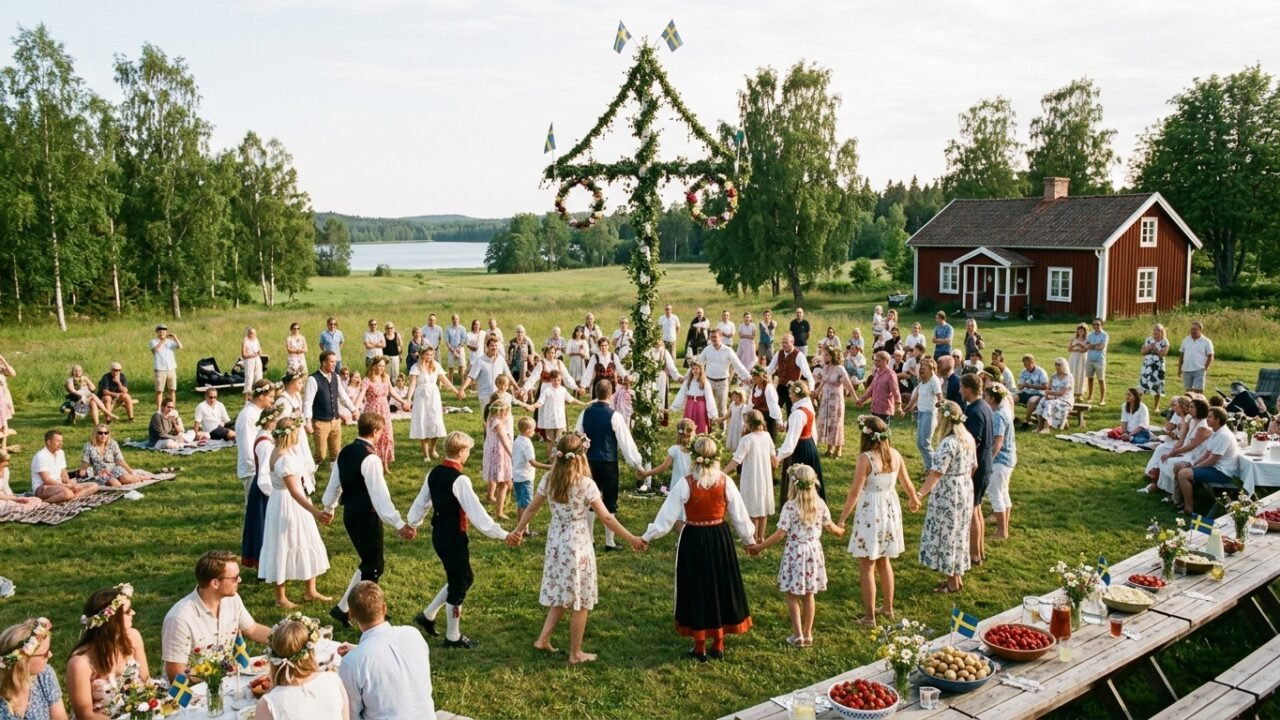
Midsommar (2019): The Complete Guide to Ari Aster’s Daylight Horror Masterpiece
Midsommar is a 2019 folk horror film written and directed by Ari Aster. It follows Dani (Florence Pugh), a young woman shattered by a sudden family tragedy, who travels with her emotionally checked-out boyfriend and his friends to a remote Swedish commune for a once-in-a-lifetime midsummer festival. What begins as flower crowns and maypole dancing curdles into something far darker, as the commune’s rituals demand more and more from its guests. This guide covers everything: the full plot, the ending explained, the cast, the real Swedish traditions the film borrows from, where it was actually filmed, and why people are still arguing about that final smile years later.
What Is Midsommar About?
On paper, Midsommar is simple. A grieving American couple joins friends on a trip to rural Sweden for a midsummer celebration hosted by a commune called the Hårga. The sun never quite sets. The locals wear embroidered white robes. And one by one, the visitors start disappearing.
But Aster’s second feature — made right after his devastating debut Hereditary (2018) — isn’t really a movie about a cult. It’s a breakup movie wearing a folk-horror costume. Aster has said the script grew out of a difficult breakup of his own, and you can feel it in every scene: the film is less interested in scaring you than in staging, with almost surgical precision, the slow death of a relationship where one person is drowning and the other has already stopped reaching for her hand.
The basics: Midsommar premiered on June 18, 2019, opened in the United States on July 3, 2019 through A24, and runs 147 minutes in its theatrical cut. A 171-minute director’s cut followed with a limited release on August 30, 2019. Made for roughly $9 million, it earned about $48.5 million worldwide — a quiet, profitable success that kept growing once it hit streaming.

Midsommar Plot Summary (Full Spoilers Ahead)
If you haven’t seen the film, stop here and come back. What follows is the complete story.
The Opening Tragedy
Dani Ardor is already anxious before anything supernatural happens. Her sister Terri, who has bipolar disorder, has been sending her ominous emails, and Dani’s boyfriend Christian won’t pick up the phone when she needs him. Then the news lands: Terri has killed both of their parents and herself, filling the family home with carbon monoxide while they slept. The film stages this with almost unbearable restraint — a slow push into the house, the hose taped to the car exhaust, Dani’s scream when the police call comes.
Christian, who had been quietly planning to break up with Dani, stays. Not out of love, exactly. Out of guilt, and because leaving now would make him the villain. That distinction matters for everything that follows.
The Invitation to Sweden
Months later, Dani’s grief has curdled into a needy, apologetic sadness that exhausts everyone around her — especially Christian. His friend Pelle, a soft-spoken Swede, invites the group to his ancestral commune in Hälsingland for a midsummer festival that happens only once every 90 years. Christian’s grad-school friends are going: Josh, an anthropology student who wants to write his thesis on the commune’s rituals, and Mark, who is mostly there for a good time. Christian invites Dani at the last minute, almost as an afterthought, and she accepts — to the visible irritation of everyone except Pelle, who seems genuinely glad she’s coming.
In Sweden they meet two more guests, an English couple, Simon and Connie, brought by Pelle’s brother Ingemar. The group drives out to a meadow that looks like the inside of a storybook, and the festival begins.
Arrival in Hårga
The Hårga greet their guests in embroidered white linen, feed them, and dose them with psilocybin mushrooms. The commune is a marvel of production design: hand-painted murals cover the walls of the sleeping hall, runestones dot the fields (Josh the anthropology nerd spots one and proudly identifies the Elder Futhark, only to be gently corrected — it’s Younger Futhark), and at the center of everything stands the maypole, waiting.
Here’s the thing most first-time viewers miss: the murals on the wall literally depict the entire plot of the film, start to finish. The maypole dancing, the cliff, the bear, the burning temple — it’s all painted there before any of it happens. Aster isn’t hiding the ending. He’s daring you to notice it.
The Festival Turns
The turn comes with the ättestupa ceremony. Two elders of the commune, having reached the age of 72 — the end of the Hårga life cycle — walk to the top of a cliff and throw themselves off onto the rocks below. The first dies instantly. The second doesn’t, and the commune finishes the job with a mallet. The camera does not cut away. The guests are horrified; the Hårga are serene. To them, this is a beautiful, voluntary completion of a life. To everyone else, it’s the moment the trip stops being a vacation.
From here the disappearances accelerate, each one tied to a small transgression:
- Simon and Connie decide they’ve seen enough and try to leave. They never make it out. (We later glimpse what remains of Simon — and it’s one of the film’s most quietly gruesome images.)
- Mark drunkenly urinates on the commune’s ancestral tree. He vanishes that night.
- Josh, forbidden from photographing the commune’s sacred text, sneaks into the temple at night to do it anyway. He’s killed mid-shutter-click.
Meanwhile, Christian is being maneuvered into position. Maja, a young Hårga woman, has chosen him for the commune’s mating ritual — a fact foreshadowed in a tapestry showing a girl placing pubic hair in a man’s food, which is exactly what happens to Christian’s pie. Drugged into compliance, he’s led into the ritual while Dani, crowned May Queen after winning a grueling maypole dance competition, is paraded around the commune in a throne of flowers.
The Final Day
The festival’s climax requires nine human sacrifices — an offering of life in exchange for life. Four outsiders are already dead. Four Hårga volunteers are chosen by lottery. The ninth and final sacrifice is chosen by the May Queen herself: Dani must pick between a randomly selected commune member and Christian.
She chooses Christian. He’s sewn — still paralyzed and drugged — inside the hollowed-out skin of a bear, carried into the yellow pyramid-shaped temple alongside the other sacrifices, and the building is set ablaze. The Hårga wail and scream in unison, physically mirroring the pain of the burning. Dani watches. She screams with them. And then, slowly, her face settles into a wide, unmistakable smile as the temple burns.
Midsommar Ending Explained
The ending is the most argued-over 20 minutes in modern horror, so let’s take it piece by piece.
What do the nine sacrifices mean?
For the Hårga, the math is spiritual, not cruel. The commune divides life into four seasons — childhood to 18, pilgrimage to 36, working years to 54, elderhood to 72 — and the festival exists to keep that cycle turning. Nine lives given so the community continues. The May Queen choosing the final sacrifice isn’t a punishment; it’s an honor, the crown’s heaviest duty. That’s what makes Dani’s choice so devastating — the film frames it as empowerment and indoctrination at the same time, and refuses to tell you which one you’re watching.
Why does Dani choose Christian?
Because the film has spent two and a half hours showing you exactly who Christian is. He forgot her birthday. He planned to break up with her before her family died and stayed out of obligation. He stole Josh’s thesis topic. When she has a panic attack, he sighs. When the Hårga women gather around Dani and breathe with her, scream with her, feel with her, Dani experiences something Christian never gave her: being witnessed. Choosing him isn’t just revenge. It’s the first decision in the film she makes for herself.
What’s with the bear?
The bear has been lurking at the edges all along — there’s a caged bear near the commune, and the film’s most chilling Easter egg hangs above Dani’s bed in the opening scenes: a print of Swedish illustrator John Bauer’s painting of a crowned girl kissing a bear, from the folk tale “The Virgin’s Hike.” The bear suit is Christian’s final costume: stuffed, hollow, worn by someone else’s design. It’s hard not to read it as the film’s verdict on who he was in the relationship.
Why does Dani smile?
This is the question the whole film is built around, and there are two honest answers. The generous reading: it’s catharsis. Dani has spent the entire film apologizing for her own grief, and in the fire she finally stops. The Hårga gave her what Christian never could — a community that meets her pain instead of managing it — and her smile is the first genuine one in the movie. Aster himself has jokingly called it the happiest ending he’s ever written.
The darker reading: she’s been absorbed. The commune love-bombed her, isolated her, drugged her, and aimed her at the one person anchoring her to her old life. The smile isn’t freedom; it’s the moment the cult’s work is complete. The brilliance of the ending is that both readings are fully supported by what’s on screen. The film doesn’t resolve the ambiguity — it makes you sit inside it while the temple burns.
The Cast of Midsommar
| Actor | Character | Who They Are |
|---|---|---|
| Florence Pugh | Dani Ardor | The grieving girlfriend at the film’s center; Pugh’s performance — often acting through pure facial expression — is widely considered the reason the film works. Interestingly, Haley Lu Richardson was reportedly offered the role first and turned it down. |
| Jack Reynor | Christian Hughes | Dani’s boyfriend, a walking case study in passive emotional neglect. Reynor plays him with just enough charm that you understand why Dani stayed. |
| Vilhelm Blomgren | Pelle | The Swedish friend who lures everyone to Hårga. Warm, attentive, and quietly the film’s most effective predator — he gives Dani the kindness Christian withholds, and it works exactly as intended. |
| William Jackson Harper | Josh | The anthropology grad student who sees the commune as thesis material first and a danger second. His academic detachment gets him killed. |
| Will Poulter | Mark | Comic relief with a cruel streak; his disrespect for the commune’s sacred spaces seals his fate early. |
| Ellora Torchia | Connie | Half of the English couple; the first guest to correctly read the danger and try to leave. |
| Archie Madekwe | Simon | Connie’s boyfriend, brought by Pelle’s brother Ingemar. |
| Isabelle Grill | Maja | The young Hårga woman chosen for the mating ritual with Christian. |
Is Midsommar Based on a True Story?
Short answer: no — but it’s built from real materials.
The Hårga commune is fictional. (There is a real village in Sweden called Hårga, and a real region, Hälsingland, where the film is set — but no flower-crowned cult is burning bears there.) The midsummer festival at the film’s center, though, is very real. Midsummer is one of Sweden’s biggest holidays, a celebration of the summer solstice that Aster researched obsessively: he visited Sweden for midsummer three times, learned the runic alphabet, and traveled through the north with production designer Henrik Svensson studying centuries-old painted farmhouses.
The film’s origins are almost comically un-mystical. The Swedish production company B-Reel approached Aster with a simple commission: write a horror movie set during midsummer festivities. He’d never been to Sweden and later joked he took the job partly out of love for Swedish cinema. The relationship story — the part that actually powers the film — came from his own life, after a difficult breakup. He also drew heavily on James George Frazer’s 19th-century anthropological study The Golden Bough, a sprawling survey of ritual and myth from which the film lifts ideas like the May Queen’s crop blessing.
So the film sits in a strange middle ground: authentic textures wrapped around an invented nightmare. Swedish audiences, by most accounts, took it in good spirits — they recognized their holiday in the maypole and the flower crowns, and understood the rest was fantasy.
The Real Swedish Midsummer Traditions Behind the Film
Strip out the human sacrifice and much of what you see on screen is genuinely Swedish. Here’s what the film borrows:
- The maypole (midsommarstång). The centerpiece of real midsummer: a tall pole (or cross) raised in a field or village green, dressed with birch leaves, greenery, and flowers. Communities gather to dance around it — and yes, the dancing really happens.
- Flower crowns. Woven from wildflowers and worn by celebrants, especially young women. In folklore, picking seven (in some traditions nine) kinds of flowers on midsummer night and sleeping with them under your pillow is said to make you dream of your future spouse.
- Små grodorna (“the little frogs”). The goofy frog dance around the maypole — hopping in a ring while singing about frogs — is a real and beloved midsummer staple, and the film’s dance sequences nod directly to it.
- The feast. Pickled herring, new potatoes with dill, cured salmon, strawberries with cream — midsummer food is a serious business in Sweden, usually washed down with snaps (aquavit) accompanied by drinking songs.
- The midnight sun. In northern Sweden the sun barely dips below the horizon in late June. The film’s washed-out, sleepless brightness isn’t a stylistic invention so much as weather reporting.
- The Hårgalåten legend. The commune’s name comes from a real piece of Swedish folklore — the legend of Hårga, in which a fiddler plays music so enchanting that dancers can’t stop until, in some versions, they dance themselves to death. Aster took the name and ran with it.
What the film exaggerates or invents: the ättestupa cliff ritual (a debated legend, not a documented historical practice), the 90-year festival cycle, the mating rituals, and — to state the obvious — the entire sacrificial program.

Where Was Midsommar Filmed?
Here’s the film’s best behind-the-scenes twist: despite being set entirely in Sweden, Midsommar was barely filmed there at all. The commune was built from scratch in an empty field outside Budapest, Hungary, where the production shot from July to October 2018.
Two reasons drove the decision. The practical one: Swedish labor law restricts film crews to eight-hour shooting days, which would have strangled a production this ambitious. The financial one, in Aster’s own words from interviews: they simply couldn’t afford to shoot in Sweden, so Hungary — with its rolling hills and generous production infrastructure — stood in.
To sell the illusion, Aster worked closely with Stockholm-based production designer Henrik Svensson. The two traveled to the real Hälsingland region to study its centuries-old painted farmhouses, and the production flew actual Swedish actors to Hungary to play the Hårga villagers. The village itself took about two months to construct, and Aster has said he wanted its geography to become second nature to the audience — “something you come to know in your bones” — so every shot orients you inside it.
The film’s early American scenes, meanwhile, were shot in Utah — the same state where Aster filmed Hereditary. So the movie’s journey from the US to “Sweden” is really a journey from Utah to Hungary, which feels appropriate for a film this committed to beautiful deception.
What Midsommar Is Really About: Themes and Symbolism
Grief, and the need to be witnessed
The film’s thesis is hiding in plain sight during the scene where Dani finally breaks down. The Hårga women gather around her, and as she sobs, they sob with her — matching her breath, her pitch, her pain. It’s the film’s eeriest and most tender moment, and it’s the direct opposite of every scene with Christian, who responds to Dani’s grief with sighs, deflection, and once, memorably, by falling asleep. Midsommar argues that grief isn’t healed by solutions. It’s healed by being seen. The commune — murderous as it is — sees her. Her boyfriend never did.
A breakup movie in a horror costume
Watch the film again with this lens and the structure clicks into place: the opening (the relationship is already dead), the middle (one partner finds a community that values her), the end (the ceremonial disposal of the ex). Every horror beat doubles as a relationship beat. The mating ritual isn’t just a cult set piece; it’s the film’s bluntest image of infidelity. The final sacrifice isn’t just a sacrifice; it’s the most dramatic “I’m done” in cinema history.
Horror in broad daylight
Midsommar contains almost no jump scares and barely any darkness — and that’s the point. Aster removes horror’s usual hiding places. There’s no night for the monster to lurk in, no shadows for the dread to pool in. The sun is relentless, the flowers are bright, and the worst things happen at noon. The effect is disorienting in a way night-horror can’t achieve: your eyes tell you everything is fine while your stomach tells you it isn’t. Cinematographer Pawel Pogorzelski shoots the commune like a travel brochure that’s slowly developing a stain.
Community as both salvation and trap
The film never lets you settle on what the Hårga are. They murder guests — and they also give Dani the first genuine comfort she’s felt since her family died. That duality is deliberate. Cults in the real world work the same way: love-bombing, shared emotion, the slow erosion of boundaries, a replacement family for the lonely. Pelle’s grooming of Dani is the film’s quietest horror — he never lies to her, exactly. He just makes sure she’s looking at him instead of Christian.
Midsommar vs. Hereditary: How Aster’s First Two Films Compare
| Hereditary (2018) | Midsommar (2019) | |
|---|---|---|
| Setting | A single family home, mostly at night | An open commune, almost entirely in daylight |
| Core wound | Grief within a family that can’t speak honestly | Grief within a couple that can’t speak honestly |
| Horror style | Slow-burn dread erupting into supernatural chaos | Slow-burn dread that never erupts — it just keeps smiling |
| The “monster” | A demon inheriting a bloodline | A community absorbing a broken person |
| Ending | Devastation presented as coronation | Liberation presented as indoctrination (or vice versa) |
| Signature image | The treehouse, the miniature houses | The maypole, the flower crown, the burning temple |
Watching them together, the pair plays like a thesis and antithesis: Hereditary is about a family you can’t escape; Midsommar is about a family you choose — and what that choice costs.

The Director’s Cut: What’s Different?
Aster’s preferred version of the film runs 171 minutes — roughly 24 minutes longer than the theatrical cut — and received a limited theatrical release on August 30, 2019 before arriving on home video.
The additions are mostly texture rather than plot: extended rituals, longer stretches of commune daily life, more breathing room for Dani and Christian’s disintegrating relationship, and a few character beats that the theatrical edit trimmed for pace. Nothing in the longer cut changes what happens — it changes how deeply you sit inside the commune before things curdle.
Which should you watch? If the theatrical cut left you wanting to live in the film’s world a little longer, the director’s cut is the richer experience. If you found the theatrical cut slow, the extra half hour won’t convert you. Most first-time viewers should start with the theatrical version.
Box Office and Reception
Midsommar was never going to be a blockbuster — a 147-minute arthouse horror film opening against Spider-Man: Far From Home and Toy Story 4 — but it didn’t need to be. On a budget of about $9 million, it grossed roughly $48.5 million worldwide, making it one of A24’s most commercially successful releases at the time.
Critics were enthusiastic: 83% on Rotten Tomatoes, 72 on Metacritic, with near-universal praise for Aster’s direction and Florence Pugh’s lead performance. Audiences were more divided — the film earned a C+ CinemaScore, the classic mark of a movie that delivers something stranger than the marketing promised. IMDb users settled around 7.1/10.
The film’s real afterlife began on streaming. Released just before the pandemic lockdowns, Midsommar found a massive second audience of housebound viewers, then a third life on TikTok and social media, where Dani’s arc made her a patron saint of the “good for her” horror heroine. Years later, the maypole dress, the flower crown, and the bear remain instantly recognizable Halloween costumes — the mark of a film that escaped the arthouse and entered the culture.
Will There Be a Midsommar 2?
Nothing has been announced, and it almost certainly isn’t happening. Aster has consistently treated his films as self-contained, and he’s since moved on to very different projects (Beau Is Afraid, Eddington). Narratively, the door is technically open — the Hårga festival runs on a 90-year cycle, and Dani’s story as May Queen could continue — but Aster has shown no interest in revisiting the commune. The film’s power partly comes from its finality: some fires you don’t walk back into.
Frequently Asked Questions
What is Midsommar about in simple terms?
A grieving young woman travels with her boyfriend to a remote Swedish commune for a midsummer festival, where the locals’ rituals turn out to involve human sacrifice. Beneath the horror, it’s a story about grief, a dying relationship, and finding belonging in the worst possible place.
What happens at the end of Midsommar?
Dani wins the maypole dance and is crowned May Queen. The commune performs its final ritual: nine human sacrifices burned inside a wooden temple. As May Queen, Dani chooses the ninth victim — her boyfriend Christian, who is sewn into a bear skin and burned alive. She watches, screams, and then smiles.
Why does Dani smile at the end?
The film deliberately leaves this open. One reading: it’s catharsis — she’s finally free of a relationship that was suffocating her and has found a community that witnesses her pain. The other: she’s been fully absorbed by the cult. Most likely, Aster intends both at once.
Is Midsommar based on a true story?
No. The Hårga commune and its rituals are fictional, though the film borrows heavily from real Swedish midsummer traditions (maypole dancing, flower crowns, the solstice feast) and real folklore like the Hårgalåten legend. Sweden’s actual midsummer involves herring and dancing, not human sacrifice.
Where was Midsommar filmed?
Mostly outside Budapest, Hungary — not Sweden. Swedish labor laws limiting shoots to eight-hour days and budget constraints pushed the production there. The commune was built from scratch in a Hungarian field. Early US scenes were filmed in Utah.
What does the bear symbolize in Midsommar?
The bear appears throughout the film — caged near the commune, and in the John Bauer painting above Dani’s bed early on. Christian’s fate inside the bear skin reads as the film’s verdict on him: hollow, stuffed, worn as a costume. It also ties to the film’s themes of ritual transformation.
How long is Midsommar? Is there a director’s cut?
The theatrical cut runs 147 minutes (about 2 hours 27 minutes). The director’s cut runs 171 minutes (2 hours 51 minutes), adding roughly 24 minutes of extended rituals and character moments. It had a limited release on August 30, 2019.
Is Midsommar scary?
It depends on what scares you. There are almost no jump scares and very little darkness — the horror is psychological and atmospheric, built on dread, grief, and deeply uncomfortable ritual scenes (particularly the cliff sequence). Many viewers find it more disturbing than conventional horror.
Read Also: The Black Phone: Plot, Ending Explained, Cast & Black Phone 2 Sequel Guide (2025)

Related Articles
Elliott Gould (Complete Guide): Life, Career, Films and TV Roles Explained
Elliott Gould went from 1970s leading man to beloved TV dad. This guide covers his life,…

DopeBox: What It Is, How It Works, and Whether It’s Safe & Legal (2026 Guide)
DopeBox: What It Is, How It Works, and Whether You Should Use It Somewhere between your…
The Black Phone: Plot, Ending Explained, Cast & Black Phone 2 Sequel Guide (2025)
The Black Phone: Everything You Need to Know About Blumhouse’s 2022 Horror Hit There’s a particular…