F75 Vaillant Boiler Error Code Explained (2026 Guide)
F75 on a Vaillant boiler usually means the boiler cannot detect the right water pressure, so it stops for safety. This guide explains what it means, the safe checks you can do, and when to call a Gas Safe engineer.
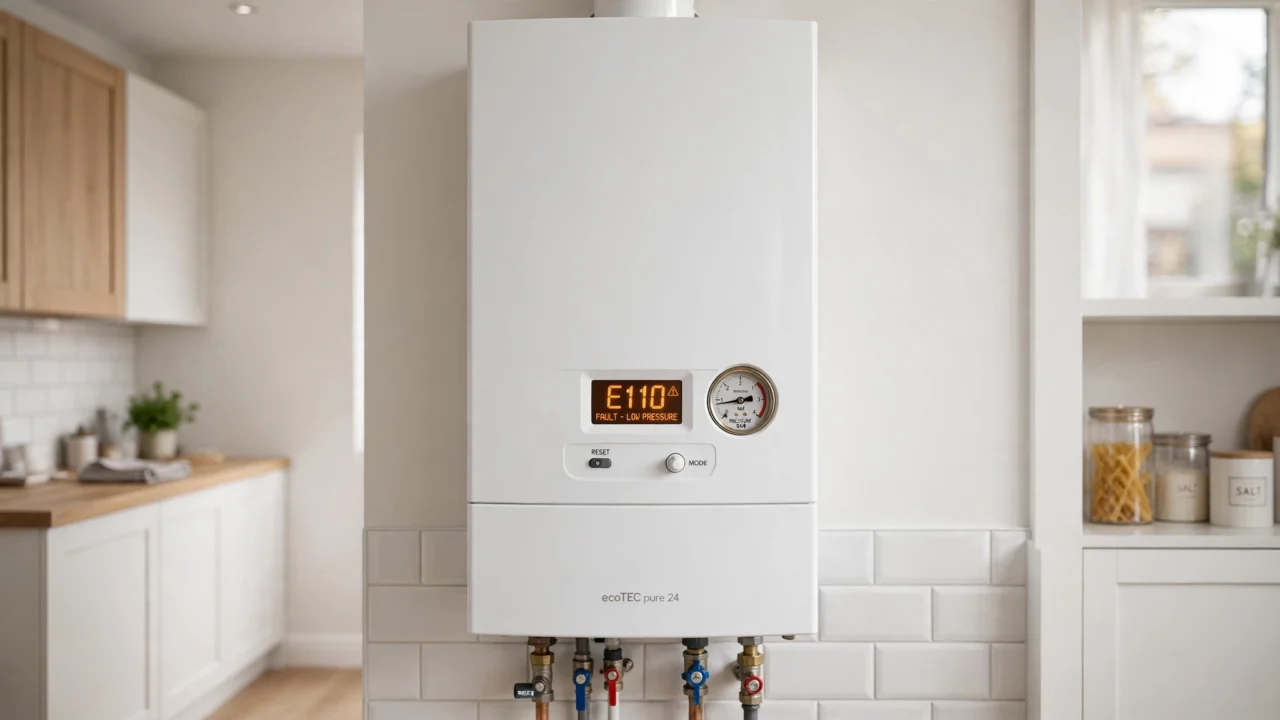
There is a particular kind of silence that follows a boiler fault code. The radiators cool, the hot tap runs cold, and a small display that you normally ignore is suddenly flashing a code you have never seen before. If that code is F75 on a Vaillant boiler, the good news is that the boiler has done exactly what it was designed to do: it has stopped itself rather than keep running with a problem it cannot verify. The bad news is that you are now without heating or hot water until the cause is found, and that part is not always obvious from the display alone.
This guide explains the F75 Vaillant fault in plain language. It covers what the code means in practical terms, the most common causes behind it, the checks a homeowner can safely carry out without touching anything inside the boiler, and the warning signs that mean you should stop and call a Gas Safe registered engineer. It also explains what an engineer will typically look at, what questions to ask before you book a visit, and how to reduce the chance of the fault coming back. Nothing here asks you to open the boiler casing, touch gas parts, or work on sealed components. Those jobs belong to a qualified professional, and that boundary matters for both safety and warranty.
In this article
- What the F75 code actually means
- The most common causes of F75
- Safe checks you can do at home
- How to reset a Vaillant boiler safely
- When to call a Gas Safe engineer
- What an engineer will check
- Preventing F75 in the future
- Frequently asked questions
What the F75 Code Actually Means
Key: F75 — a fault code on Vaillant boilers indicating a problem with detecting water pressure in the heating system.
To understand F75, it helps to know one simple thing about how a modern boiler works. A combi or system boiler does not just heat water and hope for the best. It constantly monitors the pressure of the water circulating through your radiators and pipework. That pressure needs to stay within a fairly narrow range for the system to work safely and efficiently. If the pressure is too low, the boiler may not be able to circulate water properly. If it is too high, components can be stressed. The boiler therefore relies on a pressure sensor to tell its control board what is happening inside the system.
The F75 code appears when the boiler cannot confirm that pressure is behaving as expected. In many Vaillant models, the specific trigger is that the pressure sensor does not register the expected change when the pump starts running. In other words, the boiler expects pressure to rise slightly as the pump kicks in, and when it does not see that rise, it concludes that something is wrong with the pressure reading itself, or with circulation, and it locks out. That is why F75 is often described as a pressure sensor fault rather than simply a low-pressure fault, although low pressure can be part of the story.
This distinction matters because it changes what you should do next. If your boiler showed a low-pressure code, topping up the system might be the whole answer. With F75, topping up may help in some cases, but it may also do nothing at all if the sensor itself is faulty, stuck, or blocked. Treating F75 as though it were only a low-pressure problem can therefore lead to a frustrating cycle of topping up, resetting, and watching the same code come back.
It is also worth knowing that F75 is a lockout fault. The boiler will not simply try again on its own and carry on as normal. It stops, displays the code, and waits for someone to investigate. That is a safety feature, not a flaw. A boiler that kept firing while unsure about its own pressure readings would be a much worse design. So while the lockout is inconvenient, especially on a cold morning, it is the boiler protecting itself and your home.
The Most Common Causes of F75
Several different problems can produce the same F75 code, which is one reason a proper diagnosis matters. The most commonly reported cause is a faulty or failing pressure sensor. Sensors can wear out, become blocked with debris from the heating system, or simply stop responding accurately. When that happens, the boiler receives no usable pressure signal, or a signal that does not change when the pump runs, and it logs F75.
Another common cause is genuinely low system pressure combined with a circulation problem. If the system has lost water through a small leak, a weeping radiator valve, or a recently bled radiator, pressure can fall below the range the boiler expects. Air trapped in the system can also interfere with circulation. Airlocks can stop water moving freely, which means the pump runs but pressure does not behave normally. In these cases, the underlying problem is not the sensor at all, but the conditions the sensor is measuring.
A third possibility is a pump problem. If the circulation pump is failing, seized, or not running at the right speed, water will not move through the system as the boiler expects. The sensor may be working perfectly, yet still report no pressure change, because there genuinely is no change to report. Pump faults can develop gradually, so a boiler that has been getting noisier, or radiators that have been slow to warm up, may have been warning you before F75 appeared.
Electrical and connection issues form a fourth group. Loose wiring, a damaged sensor cable, or a problem with the boiler’s control board can interrupt the pressure signal. These are less common than sensor or pressure problems, but they are also the hardest for a homeowner to identify from the outside, and they are a clear reason to involve an engineer rather than keep resetting the boiler in hope.
Finally, sludge and debris in the heating system deserve a mention. Over years of use, heating systems can accumulate magnetite sludge, a dark, gritty residue that settles in radiators, pipework, and sensors. That debris can block a sensor’s small pressure port or restrict flow through the pump. A system that has never been flushed or treated with inhibitor is more vulnerable to this kind of gradual build-up, and F75 can be one of the first visible signs that the system water is in poor condition.
Safe Checks You Can Do at Home
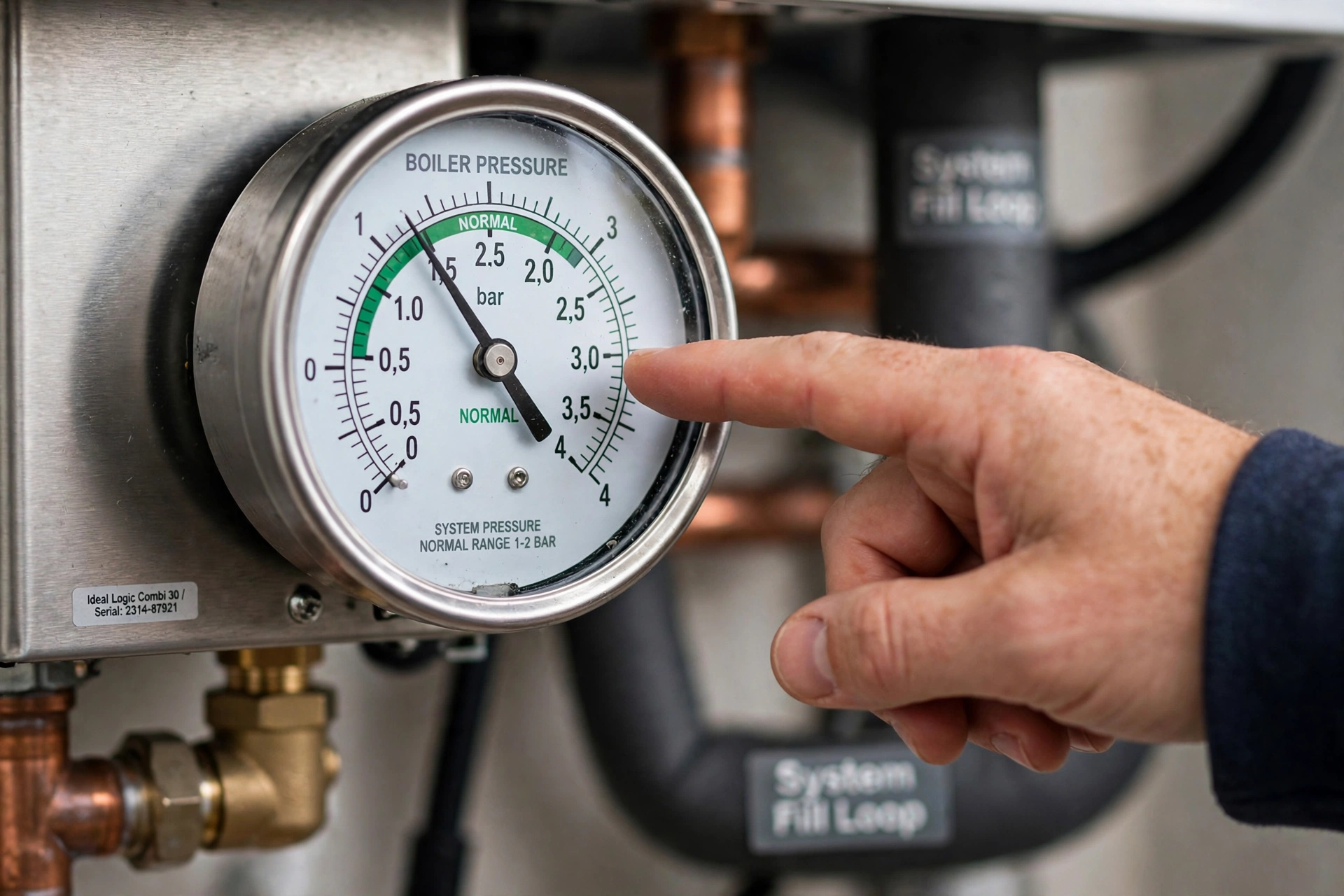
Before you call anyone, there are several checks that are completely safe for a homeowner, because none of them involve opening the boiler or touching gas components. Start with the display itself. Note the exact code, and check whether any other symbol or message is showing alongside it. If your boiler shows a pressure reading on its display, write it down. A normal cold system usually sits somewhere around 1 to 1.5 bar, but your boiler’s manual will give the exact range for your model, and that manual is the authority for your machine.
Next, look at the pressure gauge if your boiler has a visible one. If the needle is well below the normal zone, low pressure may be contributing to the fault. If it is in the normal zone and F75 still appears, that points more strongly toward a sensor or circulation issue, and it tells an engineer something useful when you describe the problem over the phone.
Walk around the house and look for obvious signs of a leak. Check radiator valves, visible pipe joints, and the area around the boiler itself for damp patches, drips, or staining. Also check whether any radiators have recently been bled, or whether work has recently been done on the heating system, because both can introduce air or drop pressure. None of this requires tools or dismantling anything. You are simply gathering information.
Listen, too. When the boiler attempts to start, can you hear the pump running? Is the boiler making unusual noises, such as loud gurgling, banging, or a pump that sounds strained? Unusual sounds do not diagnose the fault on their own, but they are useful clues for an engineer, and a boiler that sounds distressed should not be repeatedly reset.
One more safe check is the simplest of all: check that the boiler’s power supply and any external controls are behaving normally. A thermostat set far too low, a timer in the wrong mode, or a room thermostat with flat batteries can mimic a heating failure, although they do not normally cause F75 itself. Ruling these out saves an unnecessary call-out and helps you describe the real problem clearly.
How to Reset a Vaillant Boiler Safely
Key: Reset — a single, controlled restart attempt using the boiler’s reset control, not repeated pressing in the hope that the fault clears.
Most Vaillant boilers have a reset function, often a button marked with a flame symbol crossed through, or a reset position on the control dial. Your manual will show the exact control for your model, and following the manual is always better than guessing. In general terms, a reset involves pressing and holding the reset control briefly, then allowing the boiler a minute or two to go through its start-up sequence.
There is one important rule: try a reset once, maybe twice at most, and then stop. If the boiler fires up and runs normally, keep an eye on it for the next day. If F75 returns, the fault has not been fixed, it has only been postponed. Repeated resetting can mask a real problem, and in the case of a circulation or sensor fault, it can also put extra strain on components that are already struggling. A fault that returns after a reset is the boiler telling you, quite clearly, that it needs attention.
Similarly, do not be tempted to top up the system repeatedly without finding out why pressure keeps falling. Topping up is a legitimate step when pressure is genuinely low, and your manual will explain how to use the filling loop for your model. But if you find yourself topping up every few days, there is a leak or another underlying problem that topping up will not solve. Fresh water added to a heating system also brings in oxygen, which can accelerate corrosion over time, so frequent topping up is itself a sign that something needs professional attention.
If you do top up, do it slowly, watch the gauge, and stop within the normal range given in your manual. Overfilling the system creates a different problem, because pressure that is too high can trigger the pressure relief valve and cause water discharge. Slow and careful is the right approach, and if you are unsure about the filling loop on your model, that uncertainty is itself a good reason to ask an engineer to show you during a visit.
When to Call a Gas Safe Engineer
Some boiler problems can wait a day. F75, when it keeps returning, is not really one of them, because it means the boiler cannot verify its own pressure and has locked out. You should call a Gas Safe registered engineer if the code returns after a reset, if pressure keeps falling for no obvious reason, if you can see or smell anything unusual around the boiler, or if you are unsure about any step in this guide. In the UK, Gas Safe registration is the legal requirement for anyone working on gas appliances, and it is worth checking an engineer’s registration rather than taking it on trust. A genuine engineer will not mind being asked.
There are also situations where you should stop immediately and seek urgent help. If you smell gas, do not touch electrical switches, do not light anything, open doors and windows if it is safe to do so, turn off the gas supply at the meter if you know how, and call the gas emergency service from outside the property. If you suspect carbon monoxide, for example if an alarm sounds, or if people in the home develop headaches, dizziness, or nausea while the boiler is running, get fresh air immediately and seek medical advice. These emergencies are rare, but knowing the response in advance is far better than trying to work it out under stress.
For a routine F75 call-out, it helps to have a few details ready: the exact fault code, the boiler model, the pressure reading, whether the fault returns after a reset, and anything you noticed about leaks, noises, or recent work on the system. Engineers diagnose faster, and often more cheaply, when they arrive with a clear picture rather than a vague report that the boiler “just stopped working”. A short note taken at the time is worth more than a memory reconstructed days later.
What an Engineer Will Check
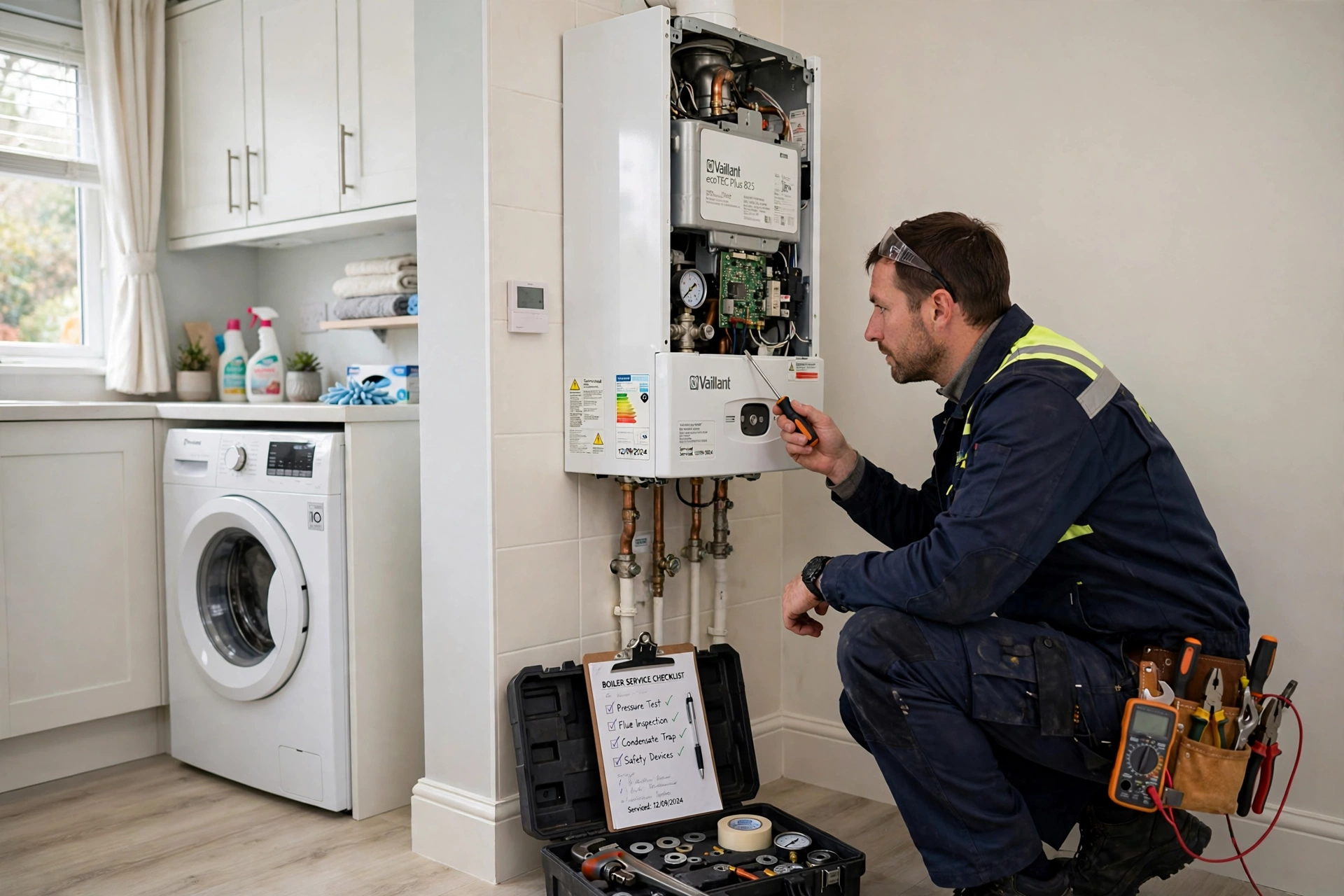
An engineer approaching F75 will usually start by confirming the fault history and checking the pressure sensor itself. That may involve testing the sensor’s readings, checking whether its pressure port is blocked, and inspecting its wiring and connections. If the sensor is faulty, replacement is usually a straightforward job, although the exact part and cost depend on the model. The engineer will also check the system pressure properly, using gauges rather than relying on the boiler’s display alone.
Next comes circulation. The engineer will check that the pump is running correctly, that valves are open, and that water is moving through the system as it should. Air in the system can be bled from radiators, and the engineer can check whether the expansion vessel is working, because a failed expansion vessel can cause pressure to swing wildly between too low and too high. Each of these checks narrows down whether the problem is the sensor, the pump, the pressure, or something else entirely.
The engineer will also look at the wider condition of the system. Dirty system water, heavy sludge, or a lack of inhibitor may be noted, and the engineer may recommend a power flush or a magnetic filter if the system is badly affected. These are not always necessary, and a good engineer will explain why they are recommending them rather than presenting them as an automatic add-on. Ask what the recommendation is based on, what it will cost, and what will happen if you leave it for now. Clear answers to those questions are a good sign.
After any repair, the engineer should test the boiler through a full heating cycle, confirm that pressure behaves normally when the pump runs, and check that the fault does not return. Do not be shy about asking them to explain what was wrong in plain language. Understanding the cause helps you recognise it if it ever comes back, and it helps you judge whether future advice about servicing or system care is relevant to your home.
Preventing F75 in the Future
Prevention will not guarantee that a sensor never fails, because components do wear out, but a well-maintained system is less likely to produce the conditions that trigger F75. Annual servicing by a Gas Safe engineer is the single most useful habit. A service includes checks on pressure, combustion, and safety devices, and it gives an engineer a chance to spot a weakening sensor or a pump that is starting to struggle before it becomes a lockout on a cold night.
Keeping an eye on pressure between services is also worthwhile. A quick glance at the gauge once a month takes seconds, and it builds a sense of what is normal for your system. If pressure starts to drift, you will notice early, while the problem is still small. Similarly, bleeding radiators only when they actually need it, rather than as a routine, avoids introducing air unnecessarily, and any radiator work should be followed by a pressure check.
System water quality matters more than most homeowners realise. Inhibitor chemicals slow corrosion inside radiators and pipework, and a magnetic filter can catch sludge before it reaches sensitive components like sensors and pumps. If your engineer mentions water quality during a service, it is worth listening, because clean system water protects every part of the boiler, not just the pressure sensor.
Finally, treat the boiler’s manual as a household document, not as packaging to be thrown away. The manual gives the correct pressure range, the reset procedure, and the meaning of every fault code for your exact model. Keeping it somewhere you can find it in a hurry, or saving a digital copy on your phone, turns a stressful fault-code moment into a calm, informed one. For broader home technology reading, the team at 9bio covers practical household topics, and DailyOrvix publishes everyday guides in a similar plain-language style.
F75 Compared With Other Common Vaillant Codes
| Fault code | What it usually points to | Homeowner action |
|---|---|---|
| F22 | Low water pressure | Check gauge; top up only if manual allows |
| F28 | Ignition failure | Reset once; call engineer if it returns |
| F29 | Flame failure during operation | Do not keep resetting; call engineer |
| F75 | Pressure sensor or circulation problem | Safe checks only; engineer if it returns |
| F83 | Temperature rise problem | Check circulation; call engineer |
This table is a rough guide only, because the exact meaning of a code can vary slightly between models and generations. Your manual remains the definitive reference for your boiler. What the comparison shows, though, is that F75 sits in a middle category: it is not an immediate emergency in most cases, but it is also not a fault to ignore or repeatedly reset away. It needs a proper cause identified, even if that cause turns out to be simple.
Pros and Cons of DIY Checks Versus Calling an Engineer
| Approach | Pros | Cons |
|---|---|---|
| Homeowner checks | Free, immediate, safe when kept external | Cannot diagnose sensor or pump faults |
| Engineer visit | Proper diagnosis, safe repair, warranty protection | Call-out cost, may need to wait for appointment |
| Repeated resetting | May restore heating briefly | Masks the fault, risks further damage |
Frequently Asked Questions
What does F75 mean on a Vaillant boiler?
F75 means the boiler cannot detect the expected change in water pressure when the pump runs. It is usually linked to the pressure sensor, low pressure, or a circulation problem, and the boiler locks out as a safety precaution.
Can I fix F75 myself?
You can safely carry out external checks, such as reading the pressure gauge, looking for leaks, and trying a single reset. You should not open the boiler casing or touch gas or internal components. If the fault returns, an engineer is needed.
Is F75 dangerous?
F75 itself is a protective lockout, not a sign that gas is leaking. However, any boiler fault should be taken seriously, and you should never bypass safety controls or keep resetting a boiler that repeatedly faults.
Will topping up the pressure fix F75?
Sometimes, if low pressure is contributing to the fault, topping up within the normal range may help. Often, though, F75 is caused by a faulty sensor or pump, in which case topping up will not clear it.
How much does it cost to fix F75?
Costs vary by model, part, and region, so no single figure is reliable. A sensor replacement is generally a modest repair compared with a pump or control-board replacement. Ask your engineer for a clear quote before work begins.
How can I stop F75 from coming back?
Annual servicing, regular pressure checks, good system water quality, and prompt attention to leaks or noisy radiators all reduce the risk. A sensor that has failed once, however, may need replacing rather than monitoring.
Reead Also: Nissan Patrol: Full-Size SUV History and Guide (2026)

Related Articles

HTTP Error 401: What It Means and How to Fix It
HTTP error 401 is the web's way of saying you need to prove who you are…

984 Area Code: Raleigh Research Triangle Cities Guide
A 984 number means North Carolina's Research Triangle: Raleigh, Durham, Cary, and Chapel Hill. This guide…

409 Area Code: Southeast Texas Cities and Full Guide
A 409 number means southeast Texas: the Golden Triangle of Beaumont, Port Arthur, and Orange, plus…
1 Comment