Mazda CX-50 (2026 Guide): Trims, Hybrid, Specs, Price and Full Review
The Mazda CX-50 is a two-row crossover with standard AWD and gas, turbo, and hybrid powertrains. This 2026 guide covers trims, specs, pricing, and which one to buy.
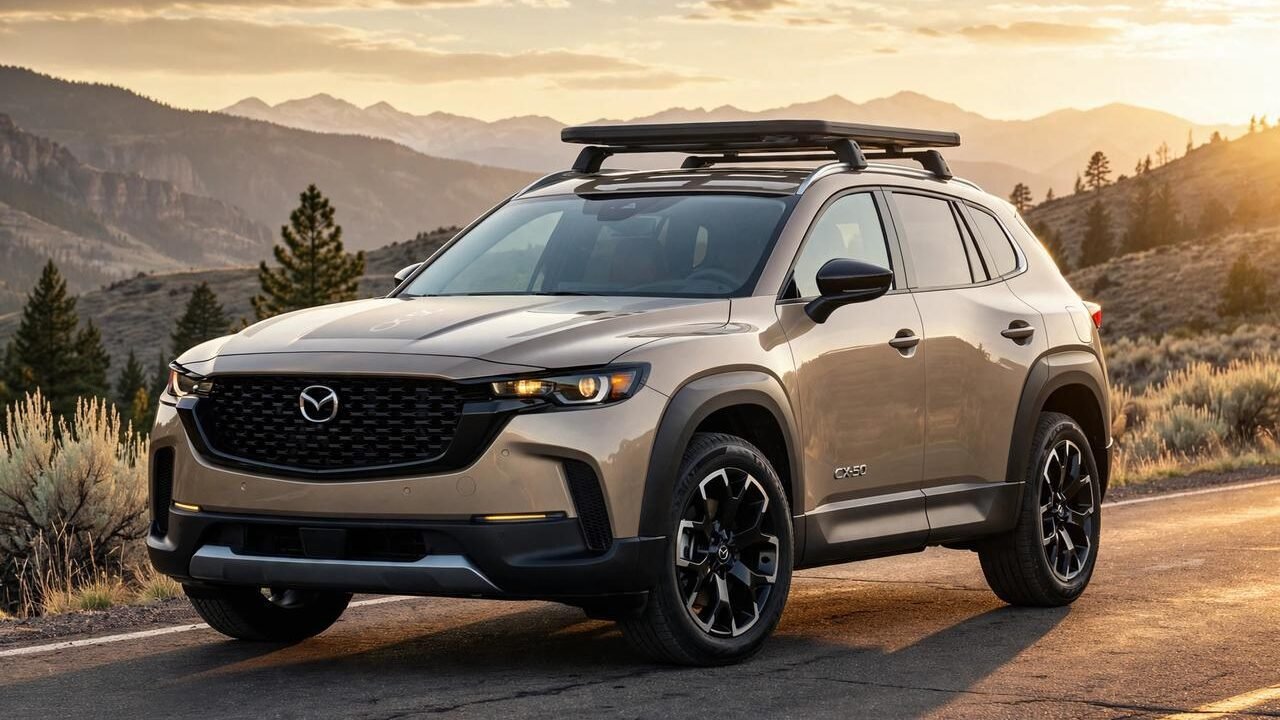
The compact SUV market is crowded with sensible choices. The Mazda CX-50 is not trying to be the most sensible one — it is trying to be the one you actually enjoy driving. Built in Huntsville, Alabama, this two-row crossover pairs standard all-wheel drive with a choice of three powertrains: a naturally aspirated 2.5-liter four-cylinder, a turbocharged 2.5-liter, and a newer hybrid that finally gives Mazda a real answer to the Toyota RAV4 Hybrid.
What makes the CX-50 interesting is not any single spec. It is the combination: rugged-leaning styling, a cabin that punches above its price, and Mazda’s long-standing obsession with how a car feels from the driver’s seat. Rivals like the Honda CR-V and Hyundai Tucson may offer more rear legroom or flashier screens, but few in this class feel as composed on a winding road.
This guide walks through everything a buyer needs to know about the 2026 Mazda CX-50: what changed this year, the full trim lineup and pricing, engine specs and real-world fuel economy, the hybrid system, interior tech, safety equipment, pros and cons, and how it stacks up against its rivals. If you are cross-shopping compact SUVs, start here.
In this article
- What Is the Mazda CX-50?
- Mazda CX-50 Engine Options and Performance
- Mazda CX-50 Trims and Pricing for 2026
- The Mazda CX-50 Hybrid: What Makes It Different
- Interior, Technology and Safety Features
- Mazda CX-50 Pros and Cons
- How the CX-50 Compares to Its Rivals
- Which Mazda CX-50 Should You Buy?
- FAQs
What Is the Mazda CX-50?
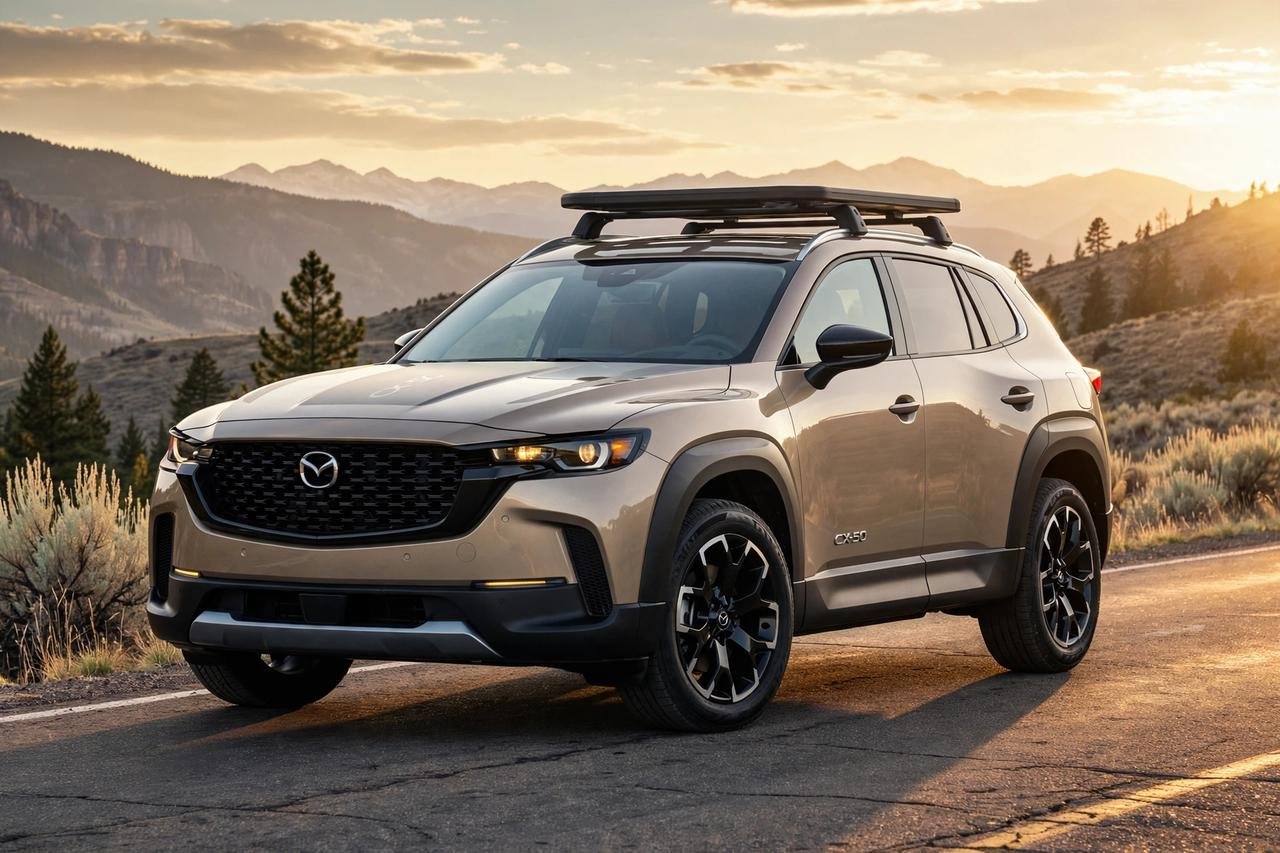
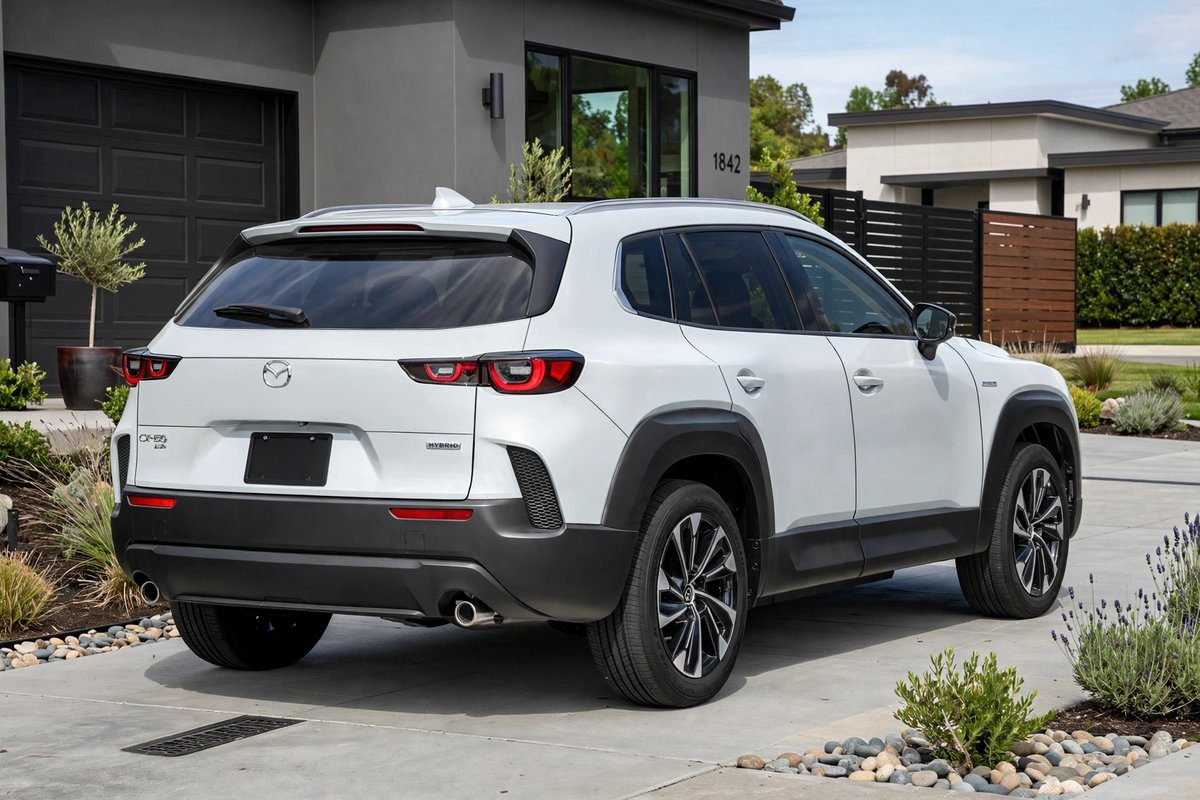
The Mazda CX-50 is a compact two-row crossover SUV that Mazda introduced for the 2023 model year, and it has quickly become one of the brand’s most important models in the United States. It sits alongside the CX-5 in Mazda’s lineup rather than replacing it: where the CX-5 leans toward refined everyday comfort, the CX-50 was designed from the start with a more outdoorsy, adventure-ready character — wider stance, longer hood, black cladding around the wheel arches, and roof rails ready for bikes and cargo boxes.
Underneath, the CX-50 shares Mazda’s front-wheel-drive-based architecture with the Mazda3 and CX-30, but every CX-50 sold in the US comes with all-wheel drive as standard. That is a genuine differentiator. Most rivals charge extra for AWD or reserve it for higher trims; Mazda simply made it the default. For buyers in the Snow Belt or anyone who regularly drives on gravel, dirt, or wet roads, that decision removes a whole layer of trim-walk guesswork.
The short version: the CX-50 is Mazda’s answer to buyers who want a compact SUV that looks ready for a weekend trip and drives like something more expensive than it is.
How the CX-50 Fits Into Mazda’s Lineup
It helps to understand where the CX-50 sits, because Mazda’s naming can confuse newcomers. The lineup now includes the CX-30 (subcompact), the CX-50 and CX-5 (compact two-row crossovers), and the larger CX-70 and CX-90 (midsize three-row models). The CX-50 and CX-5 overlap in size and price, which raises the obvious question: why does Mazda sell both?
The answer is positioning. The CX-5, redesigned for 2026, is the roomier, more comfort-oriented family choice. The CX-50 is the sportier, more rugged-flavored alternative — slightly wider, with a lower roofline, and the only one of the pair offering a hybrid powertrain. Think of the CX-5 as the sensible pick and the CX-50 as the enthusiast’s pick, even though both are perfectly practical daily drivers.
What’s New for 2026
For the 2026 model year, Mazda refined the CX-50 lineup rather than reinventing it:
- Meridian Edition expands: the off-road-flavored Meridian Edition, previously tied to the turbo engine, is now available with the base 2.5 S powertrain as well.
- Black badging: black Mazda emblems and badges appear on Meridian and turbo models for a stealthier look.
- White interior option: a new white interior choice lets buyers lighten up the cabin on loaded trims.
- Trim reshuffle: Mazda has streamlined the trim walk, so the exact grade names on dealer lots may look slightly different from the 2025 lineup.
Mazda CX-50 Engine Options and Performance
One of the CX-50’s strengths is choice. Three distinct powertrains cover three distinct buyers: the efficiency-minded, the power-hungry, and the fuel-economy-maximizing hybrid shopper. Here is what each one offers.
2.5 S: The Base Four-Cylinder
Engine: 2.5-liter SKYACTIV-G four-cylinder with cylinder deactivation.
Power: 187 horsepower at 6,000 rpm.
Torque: 185 lb-ft at 4,000 rpm.
Transmission: Six-speed SKYACTIV-Drive automatic with manual shift mode.
Fuel economy: Around 23 mpg city / 29 mpg highway / 25 mpg combined.
Towing: 2,000 pounds.
The base engine will not set your pulse racing, but it is honest, smooth, and perfectly adequate for daily driving. The six-speed automatic is an old-school choice in an era of CVTs, and most drivers will prefer it — shifts feel natural, and there is none of the rubber-band sensation that plagues some rivals. Cylinder deactivation shuts down two cylinders under light load to save fuel on the highway.
2.5 Turbo: The Enthusiast’s Pick
Engine: 2.5-liter SKYACTIV-G turbocharged four-cylinder with twin-scroll turbo.
Power: 227 horsepower on regular 87-octane fuel; 256 horsepower on premium 93-octane.
Torque: 310 lb-ft on regular; 320 lb-ft on premium.
Fuel economy: Around 25 mpg combined.
Towing: 3,500 pounds.
The turbo transforms the CX-50. That 310 lb-ft of torque arrives low in the rev range, so the car pulls strongly from a standstill and passes on the highway without drama. The clever part is the dual fuel rating: Mazda lets the engine make more power on premium fuel but runs perfectly happily on regular, so you are never punished at the pump for choosing the fun engine. Towing capacity jumps to 3,500 pounds, enough for a small camper or a pair of jet skis.
CX-50 Hybrid: The Efficiency Play
System: 2.5-liter four-cylinder paired with electric motors and a battery pack.
Combined output: 219 system horsepower.
Fuel economy: Around 38 mpg combined (roughly 39 city / 37 highway).
Towing: 1,500 pounds.
The hybrid is the big news for 2026. Mazda’s hybrid hardware is Toyota-derived — a smart move, given Toyota’s decades of hybrid refinement — and it delivers the best fuel economy in the CX-50 range by a wide margin: roughly 38 mpg combined versus about 25 for the gas models. That translates to a driving range north of 550 miles on a tank. The trade-off is towing, which drops to 1,500 pounds, and a continuously variable-style transmission instead of the six-speed automatic.
Driving Feel: Where the CX-50 Earns Its Keep
Specs only tell half the story. The CX-50’s real party trick is how it drives. Mazda tunes its steering, suspension, and throttle response with unusual care, and the CX-50 feels planted and precise in a way that most compact crossovers simply do not. Body roll is well controlled, the ride is composed without being harsh, and the cabin stays impressively quiet at highway speed. It is not a sports car, but on a winding road it is easily the most satisfying mainstream compact SUV to drive — and that is a big part of why owners tend to love theirs.
Mazda CX-50 Trims and Pricing for 2026
The CX-50 lineup is wide, which is both a blessing and a curse: there is a trim for nearly every budget, but the walk from base to loaded spans more than $13,000. Prices below are manufacturer’s suggested retail prices before the destination charge (around $1,495) and before any dealer fees or options. Always confirm current pricing with a dealer, as incentives and availability shift through the model year.
2.5 S Trims (Gas)
2.5 S Select — from around $29,900. The entry point, and a well-equipped one: 10.25-inch touchscreen, wireless Apple CarPlay and Android Auto, wireless phone charger, dual-zone automatic climate control, half-leatherette seating, 17-inch wheels, and the full Mazda i-Activsense safety suite. What you do not get: power seats, a moonroof, or parking sensors.
2.5 S Preferred — from around $32,400. Adds the panoramic moonroof, power liftgate, front and rear parking sensors, heated mirrors, an eight-way power driver’s seat, and heated front seats. Many reviewers call this the value sweet spot of the gas lineup, and it is easy to see why.
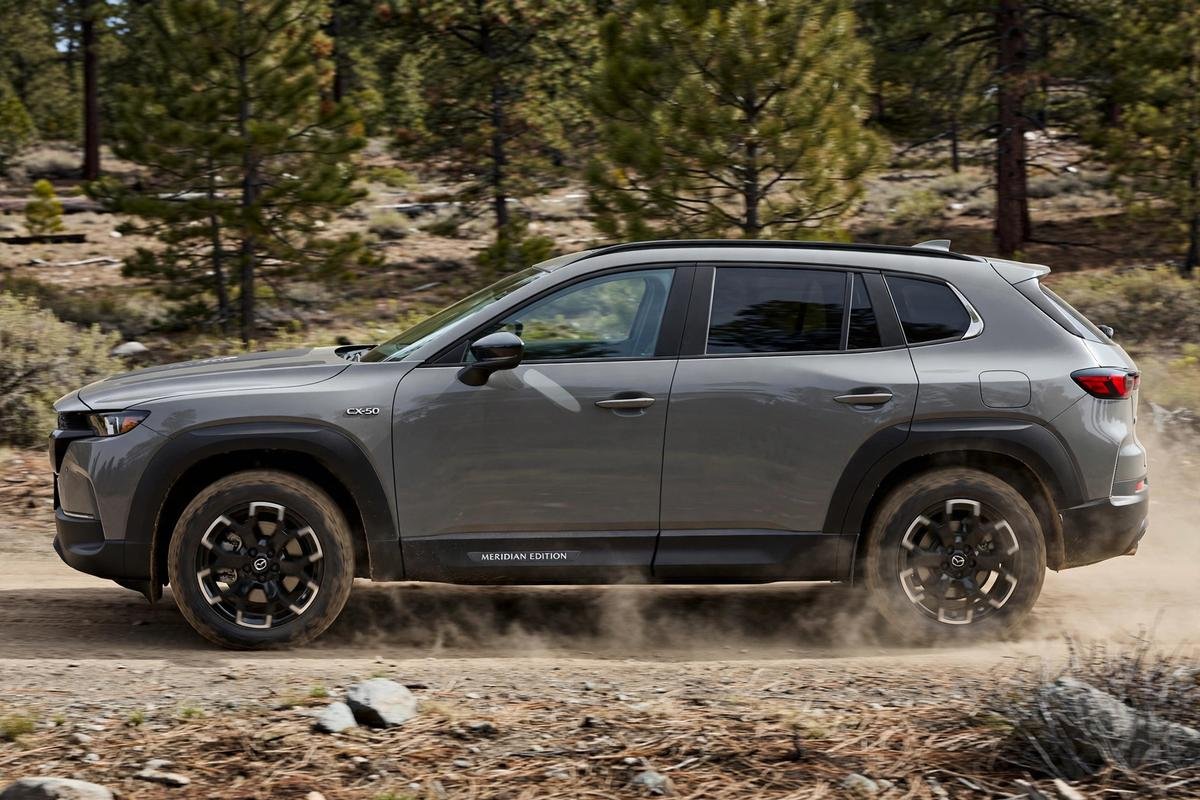
2.5 S Meridian Edition — from around $33,150. New for 2026 on the base engine. The off-road-flavored trim brings 18-inch wheels with all-terrain tires, black roof rails, black badges, and a choice of three colors (Jet Black, Polymetal Gray, or Zircon Sand) with a black-only interior.
2.5 S Premium — from around $34,900. Steps up to genuine leather seats, 20-inch wheels, ventilated front seats, a power passenger seat with memory, the 12-speaker Bose audio system, SiriusXM, and a wiper de-icer. The new white interior option is available here.
2.5 Turbo Trims
2.5 Turbo — from around $37,900. Builds on Premium-level equipment and adds the turbocharged engine, paddle shifters, adaptive front lighting, signature LED headlights, power-folding mirrors, a head-up Active Driving Display, and the full 3,500-pound tow rating.
2.5 Turbo Meridian Edition — from around $40,400. The adventure flagship: all-terrain wheels and tires, hood graphics, side rockers, Terracotta leather, heated rear seats and steering wheel, and built-in Mazda navigation. Limited to Zircon Sand, Polymetal Gray, or Jet Black.
2.5 Turbo Premium Plus — from around $42,900. The loaded turbo, with every comfort and tech feature Mazda offers on the CX-50.
Hybrid Trims
Hybrid Preferred — from around $34,750. The smart-money hybrid: heated front seats, wireless CarPlay and Android Auto, wireless charging, and most of the driver-assistance features, without paying for leather or Bose.
Hybrid Premium — from around $38,150. Adds leather, Bose audio, and more comfort equipment.
Hybrid Premium Plus — from around $40,150. The fully loaded hybrid.
Ownership costs to know: Mazda covers the CX-50 with a 3-year/36,000-mile basic warranty and a 5-year/60,000-mile powertrain warranty; hybrids add an 8-year/100,000-mile battery warranty. Those figures are competitive for the class and worth factoring into long-term ownership math.
The Mazda CX-50 Hybrid: What Makes It Different
The hybrid deserves its own section because it changes the CX-50’s value equation so dramatically. Jumping from roughly 25 mpg combined to roughly 38 mpg combined is not a marginal gain — it cuts fuel stops nearly in half and can save hundreds of dollars a year depending on how much you drive.
How the Hybrid System Works
The CX-50 Hybrid pairs a 2.5-liter four-cylinder engine with electric motors and a battery pack for 219 combined horsepower. Mazda did not develop this system alone; the hybrid hardware is Toyota-derived, which is reassuring given Toyota’s unmatched track record with hybrid durability. Around town, the electric motors handle low-speed driving and assist the engine under acceleration. On the highway, the gas engine does most of the work. A continuously variable-style automatic manages the power delivery — smooth and efficient, though less engaging than the six-speed in the gas models.
Hybrid vs. Gas: The Honest Trade-Offs
| Factor | CX-50 Hybrid | CX-50 2.5 S Gas |
|---|---|---|
| Combined fuel economy | ~38 mpg | ~25 mpg |
| Driving range | ~550+ miles | ~400 miles |
| Power | 219 hp | 187 hp |
| Towing | 1,500 lbs | 2,000 lbs |
| Transmission | CVT-style automatic | 6-speed automatic |
| Price premium | Starts ~$4,850 above base gas | — |
The math favors the hybrid for high-mileage drivers. If you drive 15,000 miles a year, the hybrid’s fuel savings can pay back its price premium in roughly three to four years at typical US fuel prices — sooner if gas prices spike. Low-mileage drivers may never recoup the difference, in which case the 2.5 S Preferred remains the rational pick.
Interior, Technology and Safety Features
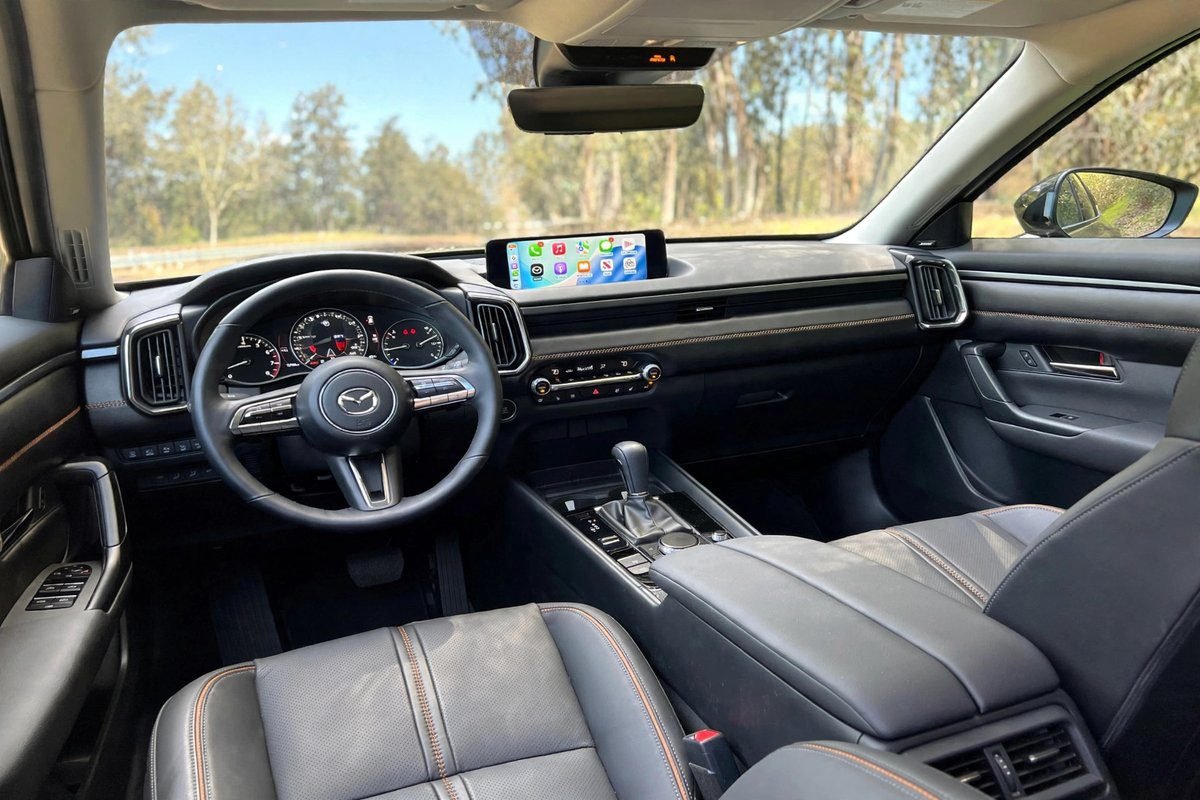
Step inside the CX-50 and the first impression is quality. Soft-touch materials cover the surfaces you actually touch, the switchgear has a precise feel, and the overall design is calm and driver-focused rather than gadget-obsessed. It genuinely feels like a more expensive vehicle — one of the CX-50’s most consistent review highlights.
Space and Practicality
Seating: Five passengers across two rows.
Cargo: Up to 56.3 cubic feet with the rear seats folded.
Rear legroom: Adequate for adults, though tighter than a Honda CR-V or Hyundai Tucson.
The one consistent criticism of the CX-50’s cabin is rear-seat space. It is fine for kids and average-size adults on normal trips, but tall passengers will notice the difference versus roomier rivals. Cargo space trails the class leaders too, though 56.3 cubic feet with the seats down handles a Costco run or a weekend’s camping gear without complaint.
Infotainment and Tech
Every CX-50 gets a 10.25-inch center display with wireless Apple CarPlay and Android Auto, a wireless phone charger, dual-zone climate control, and multiple USB-C ports. Mazda’s infotainment uses a rotary controller on the console rather than relying solely on touch — the screen does support touch input for CarPlay and Android Auto, which covers the functions most people use daily. Higher trims add the 12-speaker Bose system, built-in navigation, a head-up display, and a 360-degree camera. The interface is not the flashiest in the class, but it is logical and quick to learn.
Safety: i-Activsense Standard
Mazda includes its i-Activsense driver-assistance suite on every CX-50 at no extra cost: adaptive cruise control, automatic emergency braking, blind-spot monitoring, lane-keep assist, rear cross-traffic alert, and automatic high beams. That is a strong standard package — several rivals still gate some of these features behind option packages or higher trims.
Mazda CX-50 Pros and Cons
| Pros | Cons |
|---|---|
| Standard AWD on every trim | Rear seat tighter than key rivals |
| Upscale cabin materials and design | Cargo space trails the class leaders |
| Engaging, composed driving dynamics | Infotainment not as flashy as competitors’ |
| Three powertrains including an efficient hybrid | Hybrid tows less than gas models |
| Strong standard safety equipment | Turbo models get pricey quickly |
| Quiet, refined highway manners | No third-row option |
How the CX-50 Compares to Its Rivals
The compact SUV segment is brutal, and the CX-50’s main rivals each have a clear pitch. Here is how they line up:
- Toyota RAV4: The sales king. The RAV4 Hybrid is the CX-50 Hybrid’s direct rival, with similar efficiency and Toyota’s legendary resale values. But the RAV4 feels less premium inside and less engaging to drive. Choose the RAV4 for maximum resale confidence; choose the CX-50 for driving enjoyment.
- Honda CR-V: Roomier rear seat and cargo area, excellent packaging, and a refined hybrid of its own. The CR-V is the more practical family tool; the CX-50 is the more emotional choice.
- Hyundai Tucson / Kia Sportage: Longer warranties, bolder styling, and often lower prices with more standard tech. The Korean twins win on value-per-dollar; the CX-50 wins on interior quality and driving feel.
- Subaru Forester: Standard AWD like the CX-50, with a loyal following and great visibility. The Forester is boxier and more utilitarian; the CX-50 is more polished.
If driving pleasure matters to you at all, the CX-50 deserves a test drive before you sign for any of these. Spec sheets do not capture how a car feels, and feel is where Mazda consistently wins. For a very different flavor of rugged vehicle, the Ineos Grenadier covered by our sister site shows what happens when off-road ability is taken to the extreme. You can also browse more automotive coverage on The Modern Post.
Which Mazda CX-50 Should You Buy?
After weighing the whole lineup, here is the straightforward advice:
- Best value gas model: the 2.5 S Preferred. The moonroof, power liftgate, parking sensors, and power driver’s seat cover the features most buyers actually want, for a reasonable step up from base.
- Best for fuel economy: the Hybrid Preferred. You get the 38-mpg powertrain and the important comfort features without paying for equipment you may not need.
- Best for driving enthusiasts: the 2.5 Turbo. The torque, the paddle shifters, and the 3,500-pound tow rating make it the complete package.
- Best for weekend adventurers: the 2.5 S Meridian Edition. All-terrain tires and blacked-out trim at a price that undercuts the turbo models significantly.
The bottom line: most buyers will be happiest with either the 2.5 S Preferred or the Hybrid Preferred. Both hit the sweet spot of equipment, price, and running costs — the only question is how many miles you drive each year.
FAQs
Is the Mazda CX-50 reliable?
Mazda consistently ranks well in reliability studies, and the CX-50’s powertrains are proven designs — the 2.5-liter engines have been in service for years, and the hybrid system uses Toyota-derived hardware with a long track record. As with any vehicle, following the maintenance schedule is the biggest factor in long-term reliability.
How much does the 2026 Mazda CX-50 cost?
Prices start at around $29,900 for the base 2.5 S Select before destination charges, with most popular trims landing between $32,000 and $38,000. Hybrid models start near $34,750, and loaded turbo models top $42,000. A destination charge of about $1,495 applies on top.
Is the Mazda CX-50 Hybrid worth it?
For drivers covering high annual mileage, yes — the jump from about 25 mpg to about 38 mpg combined delivers meaningful fuel savings that can repay the hybrid’s price premium within a few years. Low-mileage drivers may be better served by the cheaper 2.5 S gas models.
What is the towing capacity of the Mazda CX-50?
It depends on the engine: 2,000 pounds for the base 2.5 S, 3,500 pounds for the 2.5 Turbo, and 1,500 pounds for the hybrid. If towing is a priority, the turbo is the clear choice.
Mazda CX-50 vs. CX-5: which is better?
Neither is objectively better — they target different buyers. The CX-5 (redesigned for 2026) is roomier and more comfort-focused, while the CX-50 is sportier, more rugged-styled, and the only one offering a hybrid. Drive both; the difference in character is immediately obvious.
Does the Mazda CX-50 come with all-wheel drive?
Yes — all-wheel drive is standard on every CX-50 trim in the US, with no front-wheel-drive option. That is unusual in this class and a genuine advantage for buyers in snowy or wet climates.
Read Also: Famous Landmarks (2026 Guide): The World’s Most Iconic Places to Know
Reead Also: Famous Landmarks (2026 Guide): The World’s Most Iconic Places to Know
#mazdacx50

Related Articles
CBR1000RR (Explained): Honda’s Legendary Fireblade Superbike
The Honda CBR1000RR, better known as the Fireblade, has been the benchmark litre-class superbike since 2004.…

How Artificial Intelligence Is Quietly Reshaping Everyday Work
AI did not arrive with a single dramatic moment. It seeped into offices through small conveniences,…

How to Wash a Wool Blanket (2026 Guide): Hand Wash and Machine Steps
Wool blankets need gentle care to stay soft and shrink-free. This guide covers hand washing, machine…
1 Comment